
Welcome to Patheon
Welcome! Here you'll learn all about this mysterious continent to the east of Pyrrhia containing three tribes and many mysteries. Enjoy your journey!
Important Resources

More
The Tribes
More
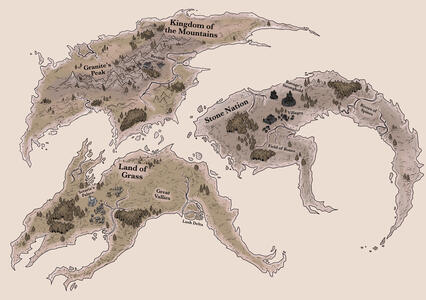
The Continent

More
Timeline
More
Misc.
The Continent - 3,548 PE (Old)
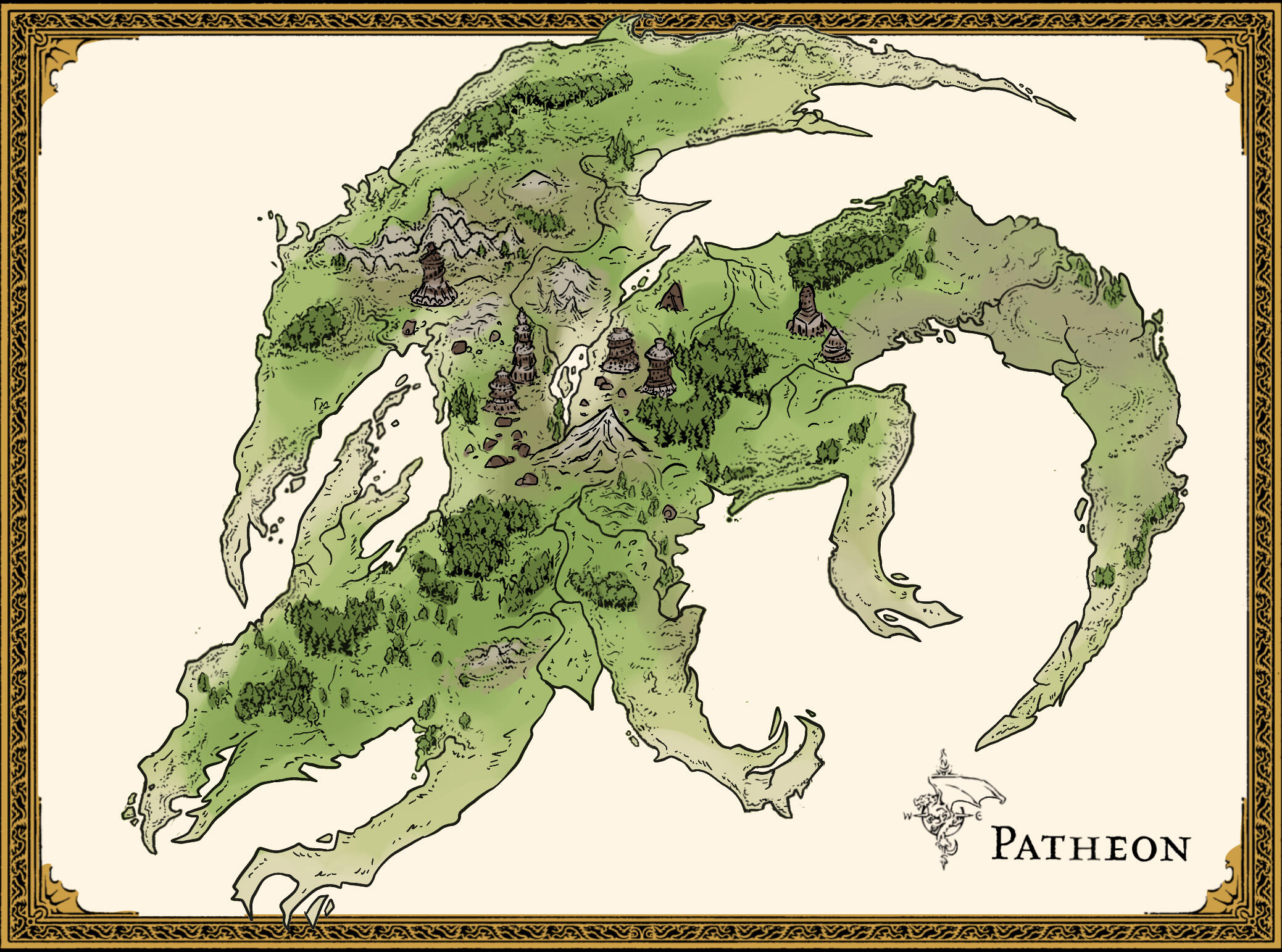
The Continent - 2,301 AE (Legends)
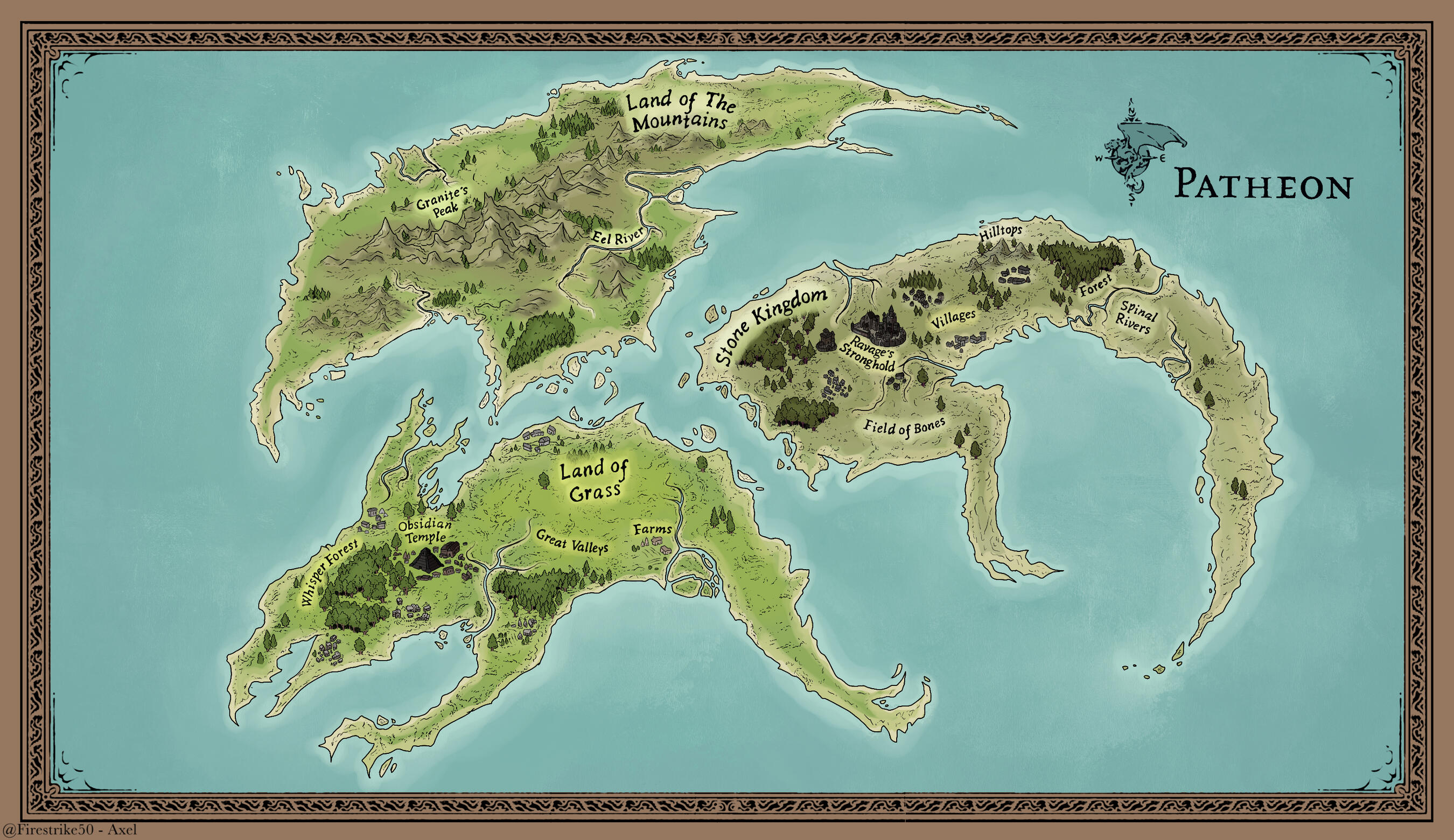
Information TBA
(See Server)
The Continent - 5,256 AS - 6,342 AE (Modern)
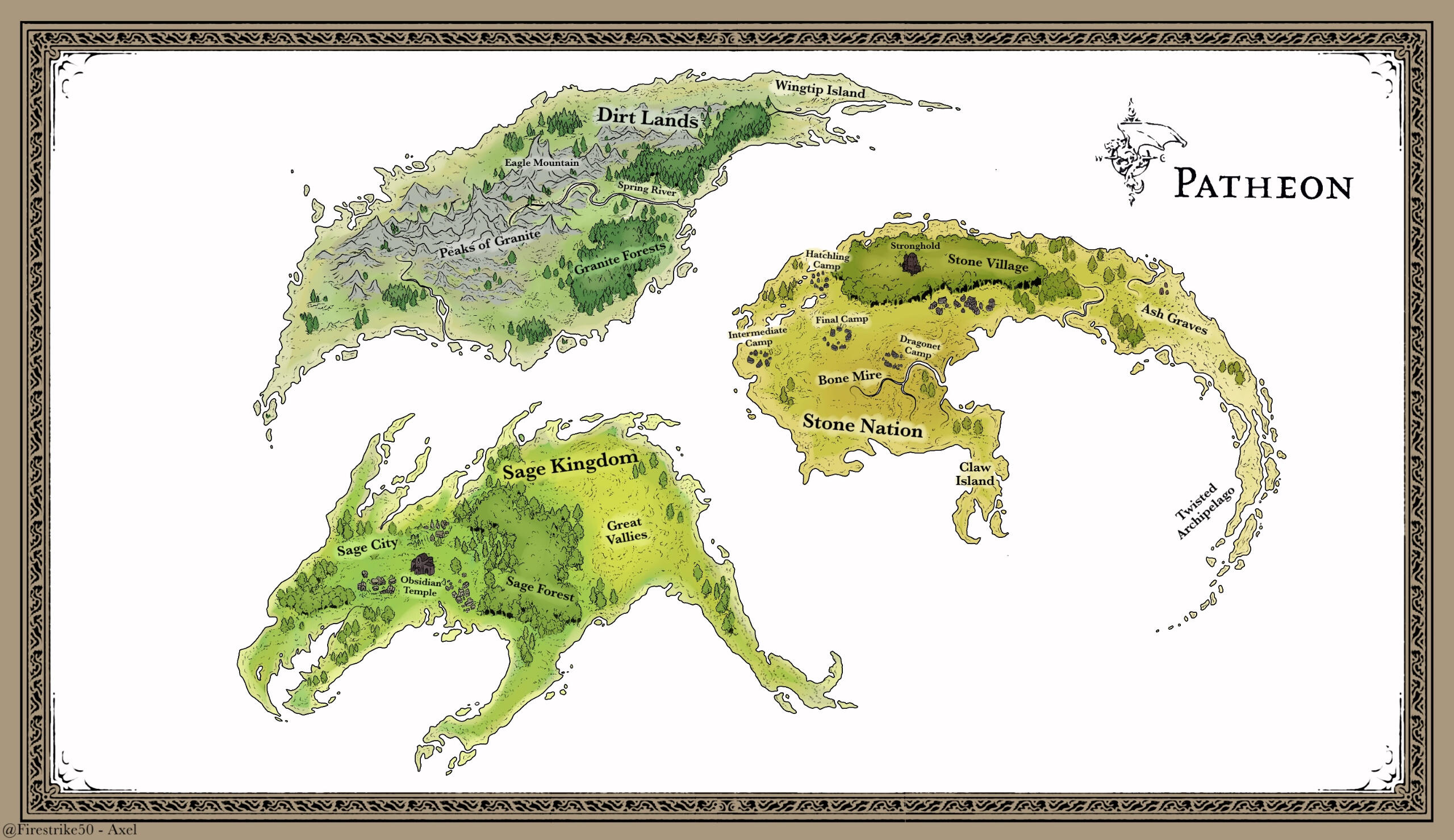
Sage Kingdom
Farmlands
Smaller more scattered villages that take care of farming and crop growth. (Chicken, horse milk, rice, oats, carrots, potatoes, various fruits, etc.)
------------------------------------------------------
Obsidian Temple
The first structure built by grasswings after The Great Eruption. A pyramid-like structure made of dark stone with a large and beautiful inner center full of carvings and statues recounting the events of The Great Eruption and the Grasswings upbringing. The carvings and murals are beautiful. This is the main place for worship of Obsidian, and the heart of the Ember Festival. This is also where Sagewing Royalty lives most of the time.
------------------------------------------------------
Sage Villages
Villages densely populating the Sage City, around the forests, rivers, and fields.
------------------------------------------------------
Great Vallies
Vast vallies to the east of the city, used for hunting and agriculture. A very good place for horses to graze as well.
------------------------------------------------------
Forests
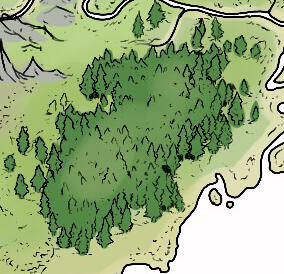
Thick forests surrounding the villages. more dense villages remain in these forests, along with marketplaces, restaurants, bakeries, horse stables, residence, tailors, and much more.
------------------------------------------------------
Armed Outskirts
The outskirts of the Sage Lands and shorlines that are lined with soldiers with armed weapons. A line of on-the-guard sagewings remain here at all times, with a system of large horns that are signaled when an incoming attack is detected, which span from the edge of the land to the dense cities.
------------------------------------------------------
Marketplace
The market area of the dense villages within the more open areas of the kingdom. Many things are sold here like bread, silverware, cheese, chickens, clothing, jewelry, art, flowers, and whatever else you can think of.


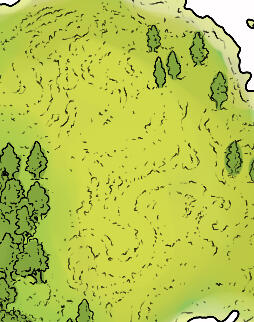
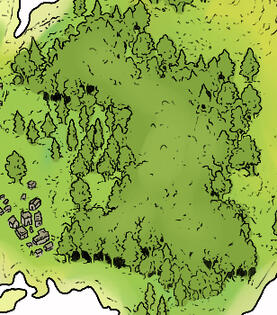
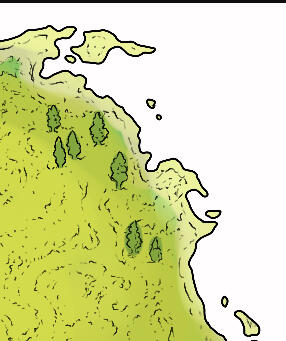

Stone Nation
Tribemaster's Stronghold
A very strong and fortified stronghold that houses the Tribemaster and many of her trusted and respected allies.
------------------------------------------------------
Hatchling Camp
The camp where Stonewings of 1-3 years old reside. This camp functions more like a nursery, but still teaches and encourages violence and the killing of others around you.
------------------------------------------------------
Dragonet Camp
The camp for Stonewings of 4-7 years old. This is the camp where actual training begins. Combat training and basic tribe history education is the goal of this camp. Once a dragonet completes this camp, they will go through the Carving Ceremony where a symbol is carved into both cheeks with a heated blade.
------------------------------------------------------
Intermediate Camp
The camp for Stonewings of 8-11 years old. Dragonets are taught about the continents geography, Sagewings, Dirtwings, dragon anatomy, and more in-depth history.
When dragonets within the camp turn 9, The Granite Trial is held. All stonewings in this age range is given a challenge to fly to the Dirt Lands, and have 3 nights to kill a dirtwing and return with it. The first dragonet to return with a successful kill is automatically moved to the final camp, and a small celebration is held where their dirtwing is cooked and served. The winner is also given an obsidian pendant as a sign of their accomplishment.
------------------------------------------------------
Final Camp
The camp for stonewings 12-13 years old. This camp focuses more on education than killing, but it is still encouraged. This is the last camp before a stonewing moves into adult society, and they will choose the job they want before graduating. All things that weren't taught before are taught in this camp.
------------------------------------------------------
Open Village
The section of the Stone Villages that remains in the open area. More marketplaces are in this spot than the wooded section.
------------------------------------------------------
Twisted Archipelago
The collection of small islands to the far northeast of Stonewing territory. Few dragons live here, but it is sometimes used for large-scale fishing, similar to Claw Island.
------------------------------------------------------
Bone Mire
A more muddy part of Stonewing land, where some dragons call home. The river spanning throughout and the lower ground level keeps the terrain consistently damp and gross.
------------------------------------------------------
Grave Digger's Huts
The small collection of huts that house the tribe's grave diggers. A diggers job is never done considering at least 10 stonewings die every day.
------------------------------------------------------
Ash Graves
A field that spans as far as the eye can see, littered with stones poking out of the ground, all with different amounts of lines chiseled into them according to the number camp the deceased was at when they died. This terrain is very soft and uneven due to the constant digging and burying of bodies.
------------------------------------------------------
Claw Island
A less alive part of the land covered in sandy grass. Some stonewings use this area for mass fishing, but it's been less effective in the passing years.
------------------------------------------------------
Stone Villages
The dense villages within the thick northern forest, housing all the stonewings who have made it to adulthood.
------------------------------------------------------
Marketplace
The area of the Open Village where Stonewings will sell their wares. Animals hides, bone accessories, art, weapons, armor, etc.


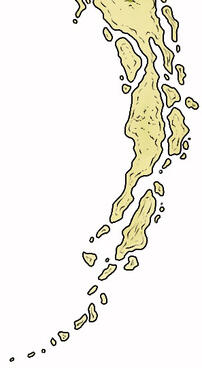
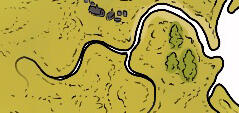

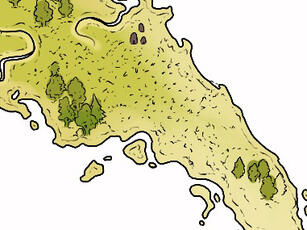
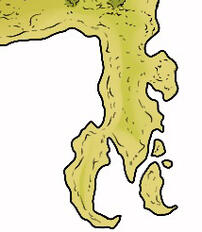
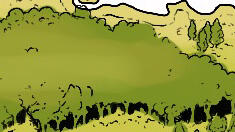

Dirt Lands
Wingtip Island
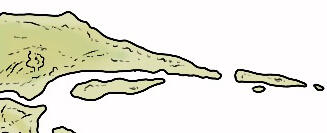
The wingtip peninsula of the Dirt lands, this area rarely sees any dragon life. Other than the occasional sick, soon to be dead dirtwing who's trying to get as far away from the dense collection of dragons as possible. This area can be seen sparsely strewn with old and new Dirtwing skeletons.
------------------------------------------------------
Eagle Mountain
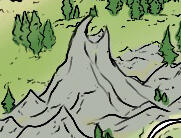
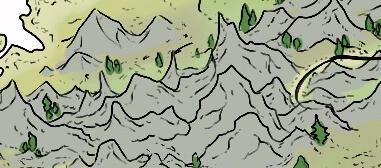
The largest mountain in the continent, with the densest collection of Dirtwings in the land. With countless caves, tunnel systems, dens and cliffsides, it's perfect for the average dirtwing. Completed with incredibly strong wings that only dirtwings have adjusted to, it makes it much more difficult for the other two tribes to fly in.
------------------------------------------------------
Spring River
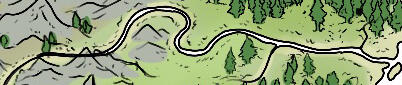
A long and winding river spanning from the edge of the east side of the land to the center of the Peaks. It sparkles like crystals in the moonlight, and its water is incredibly clear near the end of it. Perfect for drinking.
------------------------------------------------------
Granite Forests
The thick boreal forests to the southeast of the Peaks, where very few Dirtwings reside considering how many Stonewings frequent this part of the territory for food and Dirtwing hunting.
------------------------------------------------------
Granite Hills
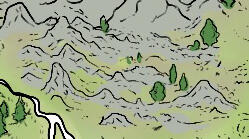
The less steep and intense range of hills to the northwest of the Peaks of Granite. Many dirtwings still live here, but not as many. More ponds and trees in this area make it more desirable for Dirtwings raising their young.
------------------------------------------------------
Peaks of Granite
The winding and dense mountain range where most Dirtwings reside. These mountains are filled with winding cave systems, cliffs, ravines, trees and ponds.
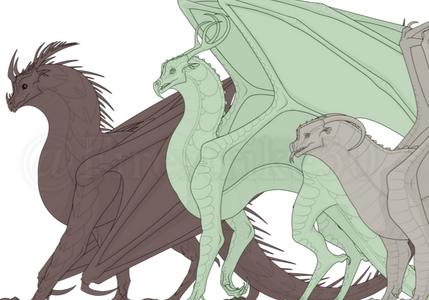
The Tribes
Modern Patheon

Dirtwings

Sagewings
Stonewings

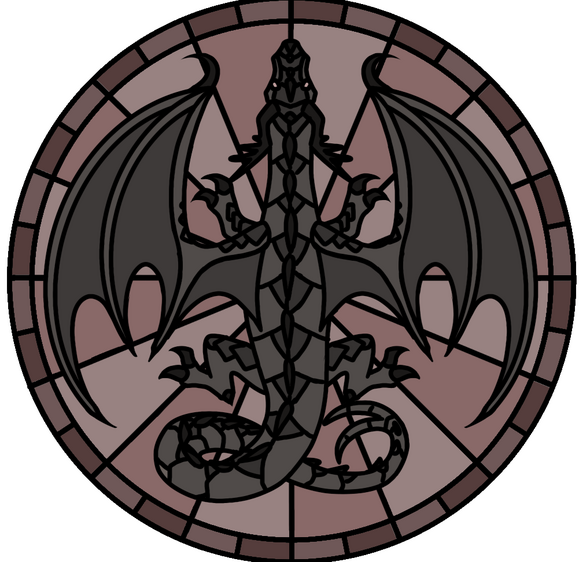
Legends: Patheon

Mountainwings
Grasswings
Stonewings


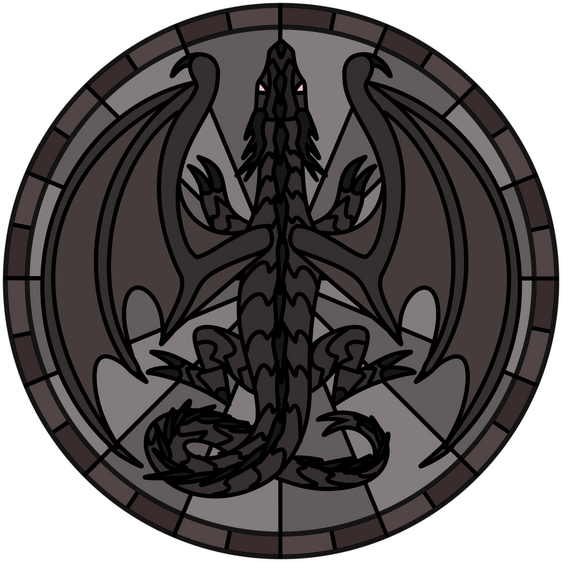
Ancient Patheon
Prongwings

Timeline
PE = Pre-Eruption || AE = After EruptionScorching Occurred in 1,086 AE
Event Key
🌾Sage/Grass
🪨Stone
🗻Dirt/Mountain
🗺️Continent-Wide
🪲Pyrrhia/Pantala
ANCIENT ERA
8,000 - 7,000 PE (9,086-8,086 BS): Pre-Scorching, Dragon Ancestors Migrate to Patheon
- Creatures that would soon evolve into dragons migrate from Pyrrhia to an eastern landmass due to over-competition and aggression from other species.7,001 - 6,599 PE (8,087-7,685 BS):🗺️Dragons Evolve
- Dragons of the land evolve and construct the first civilizations on the land, naming it Patheon, and naming themselves Prongwings. The dragons rapidly progress in technology, civilization, and culture.6,600 - 2,999 PE (7,686-4,085 BS):🗺️Prongwings Established and Thrive
- Dragons of the land of Patheon evolve and construct the first civilizations on the land, naming it Patheon, and naming themselves Prongwings.
- The dragons rapidly progress in technology, civilization, and culture. The Prongwings continue to evolve and advance rapidly, especially in things like technology, civilization, and culture.
Very few tensions arise within the tribe and it stays mostly stable, minus a few small criminal gangs and outliers.3,000 - 1 PE (4,086-1,087 BS): Prongwings Prosper
- The Prongwings continue to evolve and advance. Very few tensions arise between the tribe and it stays mostly stable, minus a few small criminal gangs and outliers.
POST-ERUPTION ERA
0 PE/AE (1,085 BS):🗺️The Great Eruption
- A colossal eruption in the center of the continent destroys almost all of the Prongwings’ kingdom, and kills over half of the population in the process. Enormous earthquakes radiate throughout the land, creating new rocky terrain. These earthquakes split the continent into three, creating gigantic gorges that reach beyond the horizon.1-9 AE (1,084-1,076 BS): Dragons Struggle/Recover
- Prongwings in each of the three now separated landmasses struggle to stay together and survive.
- 🗻On the northern land, many set up camp near the northwestern shores, as far away from the eruption site as possible. Many are ill, but one dragon named Granite decides to take charge and be a leading force for the survivors, increasing their chances of long term survival.
- 🪨On the eastern land, the dragons who survived in this area still have plentiful amounts of food and prey on the further out islands and peninsulas. They’re able to recover more easily, and believe they survived the eruption due to their strength and superiority. They begin to inhabit the remaining forests and brand new mountains and rocky terrain of this land.
- 🌾On the southern land, the collection of dragons that survived largely see this event as a sign from a higher being of some kind, and that they deserved what happened. This group of dragons begin to work on interpreting the event, planning to write it into text for future generations to follow.10-50 AE (1,075-1,035 BS): New Tribes Established
- Prongwings officially divide into three separate civilizations that reflect on how each reacted to the eruption and the mass death and tragedy it caused.
- 🗻Mountainwings, who have begun inhabiting the shores and northern mountains that survived the earthquake. They prioritize safety and community, protecting themselves from any hostile outside forces. Despite later coming into contact with Grasswings (and Stonewings to a lesser extent), they’re incredibly hesitant to form any sort of alliance or communicate any further than what they deem necessary.
- 🪨Stonewings, who inhabit the eastern land and have begun constructing their first villages. There is currently no proper leadership in place, but a small group of dragons have begun representing the tribe in any intertribal communication.
- 🌾Grasswings, who have completed their sacred text and interpretation of the events of the eruption. The dragon who spearheaded the creation and interpretation of this text becomes their leader, the empress. They attempt to convince the other two tribes of this philosophy and worldview, but they are resistant to this, which begins to create tension, as the grasswings still desire to reunite all dragons under their guidance at this time.102 AE (984 BS): Construction of the Obsidian Temple begins
- 🌾As the grasswings begin growing in numbers, they require a place of worship to go to. As a result, the entire tribe comes together to design a large temple they can all come to for safety and prayer. Valuable resources begin being gathered to construct such a structure as plans are carefully laid out.203 AE (883 BS): Obsidian Temple Completed
- 🌾After 101 years of careful planning, construction, resource gathering, tireless craftsmanship, carving, and more, the temple is finally completed and is able to be used by all citizens. This is also where future empresses will reside, as a smaller area for living is built on the top. Some are also speaking of plans to construct a stadium for entertainment and events later on.252 AE (834 BS): The First Tribemaster
- 🪨As tensions begin to bubble between the small group of dragons tasked with ruling the stonewings creating more infighting and arguments, a day comes where an argument so great comes along that it turns into a physical battle. While some attempt to break it up, one has an idea. They arrange a time for them to take turns battling eachother to the death over the course of a week, and whoever is left is the sole master of the tribe. The time comes, and the one who proposed the battle in the first place, Bloodclot, wins all the battles. She is deemed the first tribemaster of the stonewings, and from then on, she enacts a new system of ruling for the tribe, as well as steering them into the direction of valuing physical strength and will over other things.15-1,070 AE (1,070-16 BS): Tribes Evolve, Tensions Rise
- Over the next 1,055 years, the three tribes begin to evolve and change in unique ways from eachother, losing more of their prongwing features and appearance.
- 🗻🪨Throughout this time period, the stonewings begin to become more antagonistic towards the mountainwings in particular. While having small skirmishes with the grasswings due to their opposing views and a few battles, the mountainwings outright denying their authority and refusing to come to any meetings creates animosity between the tribes that begins bubbling into threats of war.
- 🗻As a result of the threat of war, many mountainwings begin creating homes underground to hide in if a war does occur. Over time, these homes will form into a more complex underground village that many mountainwings will live in. They also begin developing night vision as a result of this. Many others still choose to live on the surface though, having built many homes and community centered areas there such as schools and libraries.1,076 AE (10 BS): Grasswings Reach Out
- 🌾Grasswings attempt to reach out to mountainwings countless times to offer them asylum if they accept their worldview, but attempts still remain fruitless. Though, a small handful of mountainwings (less than 10) do flee their home to the grasslands and adopt their worldview thereby abandoning their own tribe. This small group of mountainwings take up residence in their own small settlement and live long lives.1,086 AE (0 AS):🪲The Scorching Occurs on Pyrrhia
- The Scorching takes place; an event where the dragons of Pyrrhia overthrow the humans and become the dominant species. Patheon has no contact or knowledge of Pyrrhia, so this event has no effect on their continent.1,092 AE (6 AS): First Attack on the Mountainwings
- 🗻🪨As the stonewings ready their army (having been built up by previous tribemasters who value a strong military), the stonewings perform their first proper attack on the mountainwing population, indirectly declaring war on them. Many of them are killed, and the remaining go into hiding, with a few even fighting back. Though, considering their lack of focus on combat within their education system, it’s an ineffective attempt.
- 🗻Their queen is killed in this attack, and her one heir succeeds the throne and begins to focus more on fortification and self-defense combat training for the next generation. Their settlements move closer towards/inside the mountains and caves, their old villages being mostly abandoned for the next few decades.1,103 - 1,868 AE (17-782 AS): The Stone/Mountain War
- 🗻🪨11 years after the first attack, the stonewings return with an even bigger army and attempt to hunt down any remaining mountainwings that have taken residence underground and in the mountains.
- 🗻With the stonewings unable to reach far into the tunnels, the mountainwings who weren’t caught outside and killed are safe, but this is a sign for them to continue going deeper underground in order to protect themselves. All settlements outside or in the outer layer of the mountains are completely abandoned, with many gathering resources to begin growing their own food underground.
- 🗻Mountainwings continue to train upcoming generations to defend themselves and fight, with many being posted at further out areas for alerting and defense. Many deaths continue over the years, with the mountainwings continuing to go even deeper underground every time the stonewings manage to find a way in. Technology and agricultural advancements to compensate for the lack of sunlight are advanced, and the dragons continue to fortify their underground home, blocking off any potential entries and exits, with the very few available ones being heavily guarded by soldiers willing to risk their lives for the tribe's protection. They continue to advance their kingdom entirely underground for the foreseeable future, and for the next thousand years.
- 🪨When the stonewings can no longer find any remaining mountainwings, they consider the war to be put on hold until they have reason to believe they may return. Though periodic scouting missions or search parties are still enforced.
LEGENDS ERA
2,157 AE (1,071 AS): Stonewings Overexploit
- 🪨As time goes on and the population of stonewings begins to increase, so does their reach across their land. More settlements are built, more trees are cut down, and more mountains and rocky terrain are mined into and flattened for their resources. Not only does their land become much more flat than it once was, but their wildlife population begins to dwindle, making hunting much more difficult for the average dragon. More dragons start going hungry, but this is typically only an issue seen in the outer settlements currently.__2,245 AE (1,159 AS): Stonewings Starving
- 🪨Almost a century of over-exploiting their surroundings has led to a mass starvation epidemic among the stonewing tribe. Dragons are dropping dead out in the open almost once a month.2,269 AE (1,183 AS): Ravage Hatched
- 🪨Tribemaster Harrows’ first dragonet hatches from her clutch. When this happens, she experiences a borage of delusions and “visions” of this dragonet being the tribes’ savior. In a fit of delusion and rage, she destroys all her other eggs. From this point on, she raises her daughter, Ravage, to correct her peaceful behavior by violent means throughout her childhood.
Throughout the time between Ravage’s hatching and Harrow’s death, Harrow instills new education programs into the tribe, teaching new generations to worship and respect their future tribemaster no matter what.2,273 AE (1,187 AS): Queen Mesa’s Reign Begins
- 🗻Queen Ganister of the mountainwings officially deems her daughter the new queen of the tribe. Many celebrate.2,285 AE (1,199 AS): Tribemaster Ravage’s Reign Begins
- 🪨When Ravage turns 16 years old, the battle between her and her mother arrives. It’s a relatively quick fight, but as Harrow had been building up her daughters’ reputation and enforcing education programs to influence the new generation, the entire tribe was gathered to witness in excitement. Ravage slashes her mothers throat before ripping her heart out to show to all the tribe. A large celebration follows. Ravage will continue to heavily influence the population into treating her like a god for the next few decades, along with the promise to fix the tribes’ starvation problem.2,307 AE (1,221 AS): Legends Time (CURRENT SERVER TIME)
- 🪨It’s been 22 years since Tribemaster Ravage has succeeded her mother, and her influence has spread widely throughout the kingdom. She and her inner circle promise that an end to their starvation and pain is coming very soon, within the next three years. In the meantime, most stonewings have begun resorting to travelling to the seemingly abandoned mountainwing territory to get their food. Though prey has begun running thin on the eastern side of the landmass. At this point, food is essentially used as a currency.
- 🗻With Queen Mesa having been in rule for 34 years by now, keeping the kingdom secure and safe, even if her paranoia about the stonewings may be seeping into her education mandates. Their collective fear of stonewings has developed its own unique culture of sorts, many creative types creating ghost/horror stories or political art pieces in regards to not just stonewings, but even grasswings to a lesser extent. They don’t particularly like grasswings because of their historical pushing of their philosophy onto the mountainwings.
- 🌾The Grasswings have been long-ruled by their current empress, Empress Spicata, who spearheads religious law and any judgements needed. She also encourages the top engineers to continue their work and innovate on weaponry to defend themselves from stonewings. One engineer is even in the process of developing a system to help alert the population of invasions from large distances, but this is still in progress. A large stadium is currently in progress of construction which is planned to be used for performances and events. Grasswings are generally fragmented and isolated within their unique villages, but the empress makes attempts to unify the tribe during events. However, progress is slow. Law enforcement is also rampant among all villages to the point some might describe it as smothering. Farmland and farm settlements are placed all across the land, some being in rather isolated areas.2,310 AE (1,224 AS): The Night of Peace
- 🪨Ravage and her inner circle (along with her now massive legion of devout followers) gather the entire tribe to the capital for a special event which had been planned and spread around for months. As the entire tribe is packed into the inner walls of the courtyard with the tribemaster and her followers placed along the stadium, she announces this night with two full moons as The Night of Peace. She announces by the time the sun rises again, the tribe will no longer have to worry about starving in the streets. The crowd cheers, and once it’s quiet once more, her army of followers descend from the sky and begin massacring stonewings left and right. Stonewings who are strong enough to fight off the followers manage to survive, but over half the tribe is wiped out in a single night.
- Over the remaining year, Ravage begins to introduce what will later be known as the camp system. Outer villages and settlements are demolished to make way for nature to recover, and any stonewings’ clutches are brought to a hatchery. The camps are constructed, and brand new philosophies and laws are instilled into the tribe. You must now earn your right to live.2,312 AE (1,226 AS): Mountainwing Group Disappears
- 🗻A small group of mountainwings have developed a plan to escape the underground kingdom over the last few years, and ultimately execute it. Some believe this group to have gone missing, but many believe they left on purpose, and paranoia grows over the next few years, fearing they may have been traitors. In reality, these mountainwings head for the grass kingdom.2,332 AE (1,246 AS): The First Sagewing
- 🌾🗻After one of the mountainwings who arrived in the grass kingdom 20 years ago fell in love with a grasswing, they soon have a hybrid dragonet. This dragonet is named sage, and they are dubbed a new tribe called a sagewing.2,431 AE (1,345 AS): Death of Tribemaster Ravage
- 🪨Tribemaster Ravage dies peacefully in her sleep at the age of 162, her one surviving daughter of the camps, Agony, quickly taking over her position. Her daughter will soon establish the Masters’ Sacrifice as a tradition for succeeding the position. Stonewings are currently more focused on establishing their own new form of living rather than warfare on other tribes.2,523 - 2,549 AE (1,437-1,463 AS): Mountainwings Begin Leaving Underground
- 🗻As the general mindset of royalty and the populous of mountainwings have shifted over the last 300 years, mandates on never leaving the underground begin to lift gradually. The first mountainwing to legally exit the underground stays out there for a month before returning and giving their report to the queen. This process is repeated multiple times over multiple years with the number of dragons leaving at a time increasing, and after a decade of this program, mountainwing royalty officially deems it safe to live on the surface in controlled amounts and specific locations. Many mountainwings leave and establish home on the surface, and a decent amount even migrate to the grasswing kingdom and integrate into their society, eventually creating more sagewings.3,086 AE (2,000 AS): 🪲Founding of Pantala
- Beetlewings, leafwings, and some seawings + rainwings flee Pyrrhia and travel to another continent. - Upon arrival, they discover the continent is under the control of the Othermind, and proceed to almost completely eradicate the Breath of Evil once they realize it was linked to the animals attacking them. Patheon has no contact or knowledge of Pyrrhia or Pantala, so this event has no effect on their continent.3,106 - 3,200 AE (2,020-2,114 AS): Sagewings become Majority of Grass Kingdom/Sage Kingdom Established
- 🌾🗻Sagewings (Mountain/Grass Hybrids) have become so common within the grass kingdom that pure grasswings have become increasingly rare. Over the next century, even the royal bloodline is no longer pure grass, and the kingdom and tribe are officially renamed to the Sage Kingdom.
- 🗻Mountainwings, over time, become more comfortable with their lives on the surface.3,312 AE (2,226 AS): Sagewings Establish Livestock
- 🌾With sagewings requiring meat in their diets due to their mountainwing heritage, sagewings begin to utilize livestock as more farmers adopt the practice. Meat is used in their meals and food more frequently.
POST-MASSACRE ERA
3,451 AE (2,365 AS): Massacre of the Mountainwings
- 🗻🪨Though stonewings had been aware of the mountainwings returning to the surface for nearly a hundred years now, the current tribemaster controversially put a hold on any interaction or attack. The reason for this was so that they could build up their military force and carefully devise a plan to kill as many of them as possible. Their approach was methodical and planned for years. On a night with very minimal moonlight, the stonewing army silently surrounded the settlement before performing a coordinated attack on the sleeping dragons. Nearly two thirds of them were killed that night, sending the rest of them scattering across the mountain range. The army spread out across the territory, killing any dragons they came across. This lasted for an entire month before they became harder and harder to find.3,452 - 3,976 AE (2,366-2,890 AS): Mountainwings Degrade
- 🗻🪨over the next 500 years, the stonewings continue to relentlessly attack and kill off any straggling mountainwings. With their old underground home having degraded and collapsed, hiding places became harder to find for them. If the mountainwings had any hope of their continued survival, they had to do away with unnecessary information, and only teach future generations the essentials for survival. Stonewings put effort into keeping them scattered and separated, turning them into solitary dragons over time.4,133 AE (3,047 AS): Sagewing Technology Advances
- 🌾Sagewings begin taking the threat of stonewings more seriously, making great strides in weapon technology. (Ballistas, Crossbows, projectile poisonous gasses, etc.) Though stonewing attacks aren’t very frequent, their weaponry proves effective when needed.4,944 AE (3,858 AS): Mountainwings Degrade Further
- 🗻As the killings from stonewings keep the mountainwings on their toes constantly in fight-or-flight, each generation has had to omit more knowledge or information deemed unnecessary to their survival. As a result, each generation slowly devolved cognitively, their brains not having enough room for more advanced thought over time. They revert to an almost tribal-like state, communicating with fewer words and more sounds. Dragons who hatched with traits that made it easier to evade stonewings pass their genes more frequently, so their physical evolution is rapid.
MODERN ERA
5,233 AE (4,147 AS): Mountainwings become Dirtwings
- 🗻With the mountainwings almost having completely reverted to an animal-like state both physically and psychologically, many consider the mountainwings to be extinct. The stonewings call this new tribe dirtwings. They ease on the frequent attacks they’ve been doing for the last two thousand years, allowing their numbers to return, while still hunting them for fun and for sport on occasion, and even occasionally for food.5,352 - 6,023 AE (4,266-4,937 AS): Continued Stonewing attacks against the Sagewings
- 🌾🪨As attacks against the now dirtwings begin to phase out, stonewings put much more of their focus into attacking the sagewings. Though, now that the sagewings have had centuries to advance their defenses and weaponry, attacking them in a meaningful way has proven to become more difficult. Stonewings continue to attempt to advance as well, becoming a race of technology more than a war.6,097 AE (5,011 AS): The False Brightest Night
- On one night, a comet passes through the sky. This is noticed by many dragons across the land.6,221 AE (5,135 AS): Sagewings Rediscover Gunpowder
- 🌾Sagewings rediscover the use and utility of gunpowder as their prongwing ancestors did. Though, instead of using them for fireworks, they are used for weaponry to defend themselves against the stonewings. Engineers and scientists are finding new ways to use it constantly.7,041 AE (5,955 AS): Empress Meadow’s Reign Begins
- 🌾Meadow gains the title of Empress at age 15 in the Passing of the Crown Ceremony.7,042 AE (5,956 AS): Last Major Attack on Sagewings
- 🪨🌾Tribemaster Fracture performs what will later be known as the last major attack on the Sagewings in recent history. The stonewings charge the Sagewings land, but are taken off guard by the Sagewings weapon advancements (i.e gunpowder utilization & defense formations) As a result, nearly two thirds of the adult stonewing population is wiped out. Fracture spends the next few years performing damage control/amping up breeding programs7,060 AE (5,974 AS): Tribemaster Lifetaker’s Reign Begins
- 🪨Lifetaker kills her mother, Tribemaster Fracture, in the Master’s Ceremony, deeming her the new Tribemaster at age 20.7,244 AE (6,158 AS): Current Time
- 🌾The Sagewings have been prospering quite well with advancing technology. They remain peaceful within their own kingdom, and value community and caring for one another over all else. Their defenses and weaponry remain sufficient in warding off stonewings, their last defense seemingly having deterred them from any other attacks for the last 70 years. The current empress is putting a majority of her time into focusing on technology advancement and improving laws so her future daughter can follow in protecting the tribe. More of their culture and religion can be read about in the Patheon Website.
- 🪨Stonewings are primarily focused on repopulating their adult population currently after their last official attack on the sagewings 70 years ago wiped out just over half of their adult population. The current tribemaster is constantly discussing attack plans and more with her inner circle, as well as having implemented new laws and programs to help boost their population and increase the quality of camp training and education. Stonewings grow up in a series of camps that focus on fighting one-another and proving your right to live as an adult by killing others.
- 🗻The Dirtwings do not maintain any proper civilization within their territory, considering they’re not a proper tribe, nor are they considered intelligent by stonewings or sagewings. They function as a wild animal species, occasionally being hunted by stonewings for sport or for food. This causes them to have a biological fear of stonewings, and an incredible distrust of sagewings if they are ever to come across one. The ruins of the bygone age of Mountainwings may remain buried miles underground within the depths of the mountains and caves, but these are only rumors.
Misc.
Sagewings
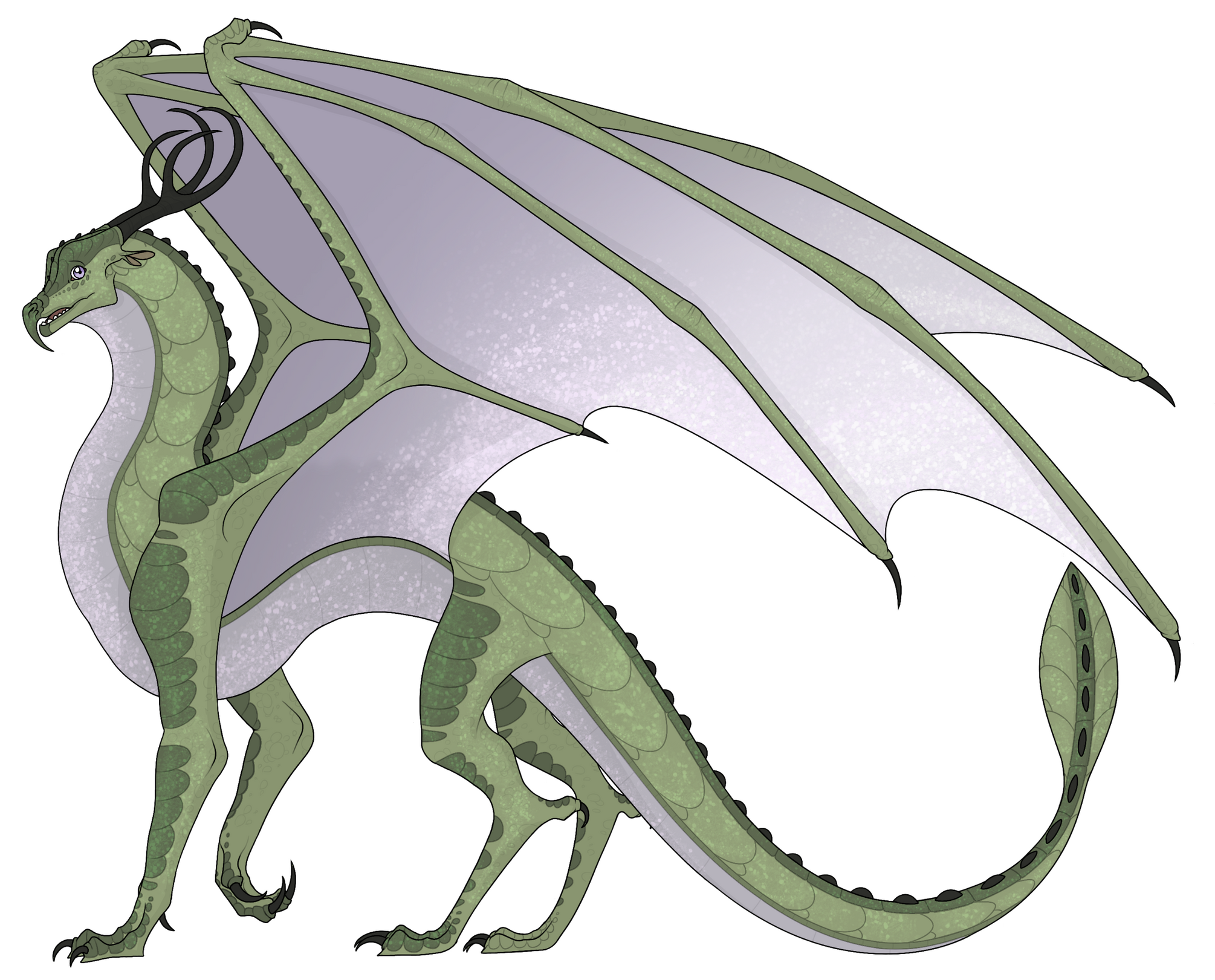
Basics
Sagewings are omnivorous, peaceful dragons who populate the southern landmass of Patheon, surrounded by lush woodlands, grasslands and fields. They’re known for their rich culture and dedicated belief system. Their most striking characteristic is their religion, which was shaped by The Great Eruption and how their ancestors retold and interpreted the event, documenting all in text which the tribe still follows over 7 thousand years later. Sagewing clutch sizes never exceed 1 at a time. They are currently ruled by Empress Meadow.
Intelligence
Sagewings are a very intelligent tribe, one might argue the most intelligent in Patheon. Their entire civilization is built upon their dedication to their religion and their love for art and self-expression, as well as caring for one another and maintaining a sense of community.
Sagewings love art of all kinds. They’re particularly fond of performance, theatre, and music first and foremost. Putting on a show, dancing, or playing music is the way sagewings have preferred to express themselves and entertain others for thousands of years, but many are also prolific in mediums such as weaving, painting, writing, carving, pottery, architecture, and much more.
Within the last few hundred years, sagewings have ramped up their advancements in weaponry in order to defend themselves against stonewing attacks. Their discovery and utilization of gunpowder is one of the only things keeping them from being overthrown, and engineers are always hard at work ensuring their weapons continue to improve in both effectiveness and resource efficiency.
These dragons have also made countless advancements in terms of technology and other various things. These include; fruit fermentation, creating paper, processing fibers, tapestries, weaving, instruments/music theory, projectile weapons, farming, advanced agriculture, baking, cooking, use of milk, advanced culinary techniques, livestock management, architecture, science, math, engineering, and more.
Sagewings are also familiar with the concept of pets. One thing this tribe loves is horses, many keeping them as pets and having small stables connected to their homes for them to stay in. Being a horse breeder is a job, and those who do so may breed for specific colors or traits to put up for adoption. Sagewings also have strict laws in place regarding horses, being that you can’t take one from the wild unless it’s too injured or weak to survive. The sagewings have a separate captive population of horses they use for pets and livestock. Eating or harming horses is also completely forbidden, but many are used in farms for their milk.
Society
Sagewings are community-centered dragons. It’s believed the best way to live is to be present in your community and help your neighbors when you can. Their religion and practices aid in maintaining this, as sagewings all have worship schedules, making it easier to come together for a common goal. For the last few thousand years or so, the ancient texts of Obsidian's word have been interpreted in a slightly different way than before. The interpretation of The Word of Obsidian has shifted slowly throughout history, so this isn’t a new thing. While focus used to rely solely on appeasing obsidian through sacrifice and selflessness to her and her alone no matter what, the more recent interpretation has become to honor her and appease her through coming together and being selfless to one another. Coming together, caring for one another and bonding is believed to be its own spark that keeps Obsidian alive, and it also makes for a healthier community and, frankly, less tyrannical Empresses.
A vast majority of the sagewing population lives in a large collection of villages and farms, essentially a city, all surrounding the Obsidian Temple. Various schools, nurseries, libraries, stores, food providers, and more all scatter the city. Anything you could need is likely less than a half-hour flight away. One of the centerpieces of the city is the massive stadium where yearly performances and events take place. There are countless other ancient buildings in the city that were built during the age of the grasswings. These buildings are greatly revered and have a very different style of architecture to them compared to most modern buildings.
While interpretations of the ancient texts may have shifted slowly over time, certain things remain concrete and unchanged. One of these being in relation to the use of fire. The only dragon allowed to breathe fire directly from the body will always and only ever be the current Empress. Anyone else attempting to breathe fire is met with a death sentence under the belief that their cycle will end, and their essence will spend eternity in a cold, dark wasteland. However, the average dragon is still permitted to use fire via kindling and other external means under very specific circumstances; Funerals, Ember Festivals, Future Empress Hatchings, Passing of the Crown ceremonies, cooking (if the food is for more than just yourself), and warmth (during the winter, for more than just yourself).
Sagewing beliefs dictate that a dragons’ life is not a singular one-time event, but rather a series of cycles from one death and birth to the next. This is the intended path that Obsidian has laid out for them, and any serious crime against her or the tribe results in the complete stop of your cycle, with whatever remains of your essence being condemned to a cold, freezing eternity with no light.
Customs
Sagewings have countless customs, celebrations, and other various small rules to follow in their society.
Ember Festival
This is by far the largest celebration in the kingdom, outside of the Passing of The Crown. This festival is held for multiple reasons, being the passing of the year, celebrating the longevity of Obsidian, and the largest mass worship the tribe does. Piles of offerings, bloodletting, praying, and more. Special treats and goods are baked, large pots of stew and soup, fresh wild-hunted meat, dancing, singing, theatre performances, group painting, and so much more. The festival is officially begun when the Empress lights the Obsidian Torch with her firebreath, one of the only occasions she’s permitted to use it.
Passing of The Crown
This is the most sacred and widely attended event in all of sagewing civilization. On the day the daughter of the Empress turns 20 years old, the ceremony is carried out. The entire tribe will attend as the Empress leads her daughter to the entrance of the Obsidian Temple, and the daughter will present her wrist. The empress will make a cut in her daughter’s wrist, and drip the blood into a sacred bowl. She uses this blood to mark the royal symbol on her daughter's head. Once this is done, the daughter will light the Obsidian Torch with her firebreath, thereby deeming her the new empress.
The mother will continue to live alongside her daughter and provide assistance when possible, though taking on significantly fewer responsibilities for the next 20 years. If these 20 years pass and the mother is still alive, she will sacrifice herself in order to permit her daughter to have dragonets, continuing the cycle. An empress’s mother and daughter cannot be alive at the same time.
Funerals
Funerals are a time of contemplation and community for sagewings. Family and friends of the deceased will gather at the center pit near the Obsidian Temple. The body will be lowered into the pit, which has been used for funerals for thousands of years. The body is set ablaze, and whatever ashes remain are retrieved and embedded into the dirt. The location can vary depending on the deceased’s final wishes.
Ex-Empress Funerals
When a previous empress passes away, the funeral service is much more grand than any other funeral. A separate fire pit is in place for empresses (again, used for thousands of years) and is lit by the current empress, using her firebreath. The previous empress is covered with soft cloth and flowers, typically each individual flower being placed by a different citizen. Her ashes will be spread to the earth just like any other dragon, but a very small portion will be kept in the Obsidian Temple.
Hatchings
When a dragonet is hatched, family and family friends will gather to celebrate, usually by cooking food for one another, singing, and dancing.
7th Hatching Days
On every sagewing’s 7th hatching day, they are required by law to come to the Obsidian Temple and perform their first bloodlet at the center offering area. A single cut and a few drops into the receptacle is all that’s needed.
Yearly Offerings
Sagewings are required to offer to Obsidian at the temple at least once a year. Offerings can be either food, jewelry, artwork, blood, tears, or other physical things.
Various Other Customs
One of the other smaller customs that sagewings have is that speaking aloud after sunset and before sunrise is forbidden. This is why sign language is one of the first things a sagewing is taught, as it is commonly utilized at night.
Royalty
Empress
The Empress is the sole ruler of the Sagewings and also carries a role similar to a priest. All religious matters are dictated by her, as she is seen as the closest to Obsidian. Any major changes in laws or public programs are decided and executed by her alone. Some empresses in the past have developed councils to help with making decisions, but this is not the norm. When an empress decides she is ready to begin raising her successor, she will have one egg at a time until she hatches a female.
Daughter
Once one female is hatched, the Empress will raise her either on her own or with her partner. The Princess is educated by her mother and the highest scholars in terms of their culture and sacred customs, but most other aspects of education are left to public teaching, as it is important in sagewing society for their future rulers to not be raised sheltered. A good empress grows up alongside her people and witnesses what life is like for them firsthand, but may still have private tutors for more advanced education as she grows. This upbringing also allows her to make friends and find community, which is a key value for the tribe.
Sons
When an empress hatches a son, they are sent to be raised by a trusted surrogate. Empresses will interact with their sons on occasion, but it doesn’t take priority. Sons of the empress are also allowed to interact with their sister when possible, or if they happen to be in the same school or area, as well as being allowed to know that they’re related. They hold no higher stance or title than the average citizen, and are treated like anyone else.
The only difference in how they are treated is the incredibly strict law forbidding them from fathering biological children, as the ancient texts dictate they cannot complicate the most sacred bloodline in the tribe. These dragons are more than welcome to adopt, but if it is discovered they have fathered biological dragonets, the eggs and/or dragonets will be sacrificed. An empress and her brothers typically have a strong bond.
Powers
Sagewings of the Empress’s bloodline are capable of fully breathing fire. All other sagewings are only physically capable of coughing up a few sparks due to the banning of firebreath for thousands of years. Sagewings are also capable of handling much higher intensities of light without damaging their eyes. Their flattened-club-like tailtips also allow for unique combat abilities, as well as assistance in tilling soil. Their long hard beaks also make it easy to break into hard shelled plants and fruits, alongside packing a devastating bite if it was ever needed.
Appearance
Sagewings are lean, graceful dragons with pronged antler-like horns that can twist and curl into almost any shape. The edges of their snouts point down into a long hard beak that can break open many hard shells and materials, and the shape and curve of the beak can vary between dragons. The ends of their tails widen and flatten into a hard shield-like shape. Their faces typically have unique scale patterns and shapes around the eyes. All sagewings have shimmering scales that sparkle and glitter in sunlight like gemstones or fresh snow.
Coloration
Sagewing colors can be any shade or form of Purple, Pink, Yellow, Green, or Pale/near-white variations of said colors.
Diet
Sagewings eat a wide array of foods, typically cooked and prepared with multiple ingredients (i.e bread, cheese, milk, yogurt, oatmeal, stew) but many of these dishes incorporate meat of various types (Chicken/duck/poultry, bison, hog, goat, rabbit, deer, quail, etc.) Many dishes also include vegetables and fruits of various kinds (namely apples, lettuce/leafy veggies, carrots, onions, tomatoes, potatoes, wheat/grains/oats, rice, berries, etc.)
Names
Sagewing names tend to fall under the following themes; Grassland Plants, Woodland Animals, Plant Anatomy, Pleasant/Holy Concepts, Music/Sounds, and Light
Stonewings
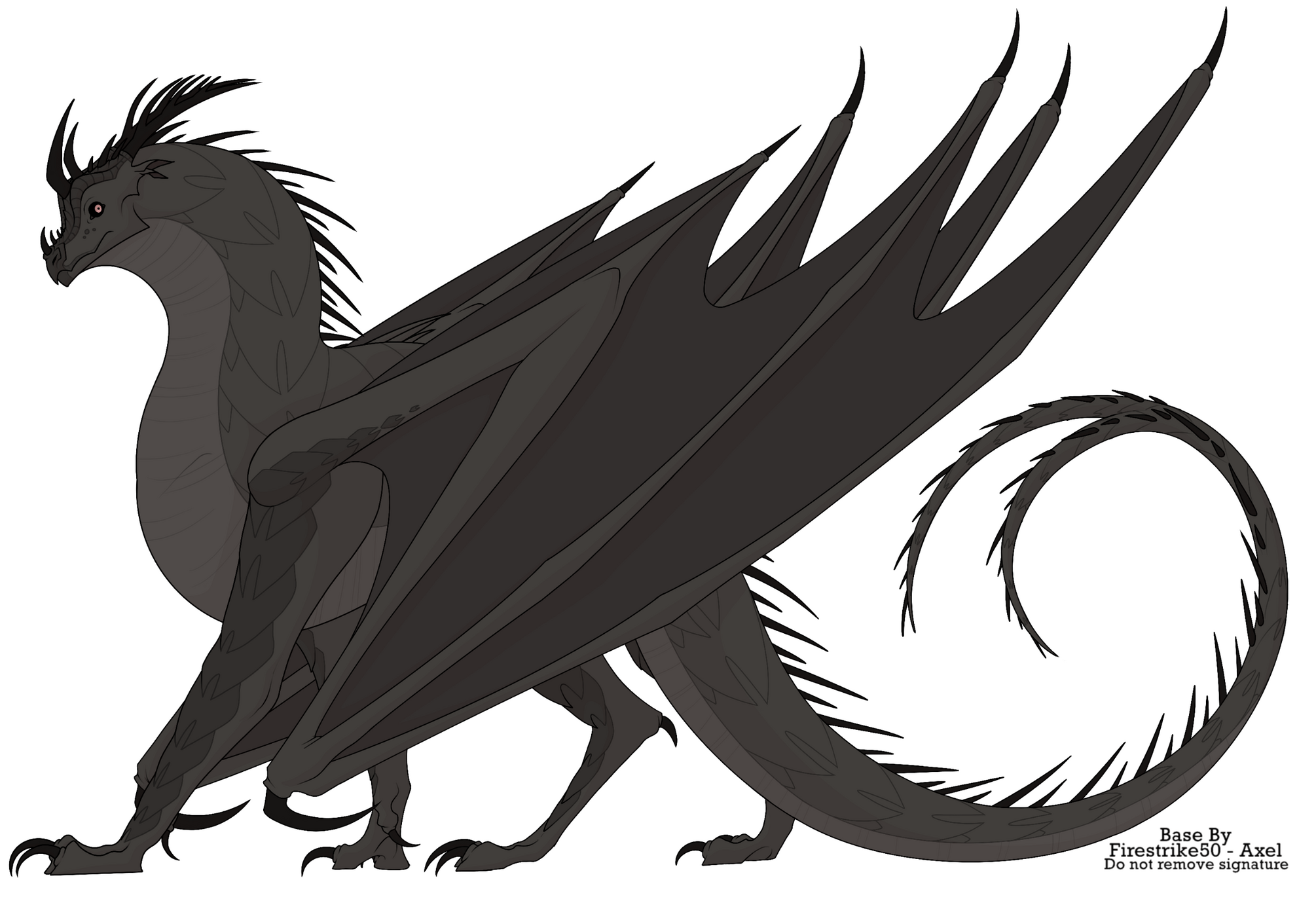
Basics
Stonewings are aggressive, carnivorous dragons that populate the eastern landmass of Patheon, which is covered in mires, thick forests, straths, and other rocky/hilly terrain, along with an archipelago. Though, most of them live in the forests and straths. Stonewings are known for their incredibly cutthroat and violent culture. On average, once a stonewing hatches, they have an incredibly low chance of reaching adulthood, and even more so if they prefer to avoid violence or killing. Their worship of violence and proving yourself strong enough to deserve to live can almost be considered cult-like.
This tribe has held a steadfast belief for over 7 thousand years, that being that they deserve to rule over all three lands of Patheon, and have both tribes completely wiped out. Throughout all this time, stonewings have also developed an ancient habit of over-exploiting their surroundings. While it’s not nearly as dire as it was before the era of The Night of Peace, the territory the dirtwings inhabit still suffers due to this fact.
On average, stonewings will lay clutches generally ranging from 12 to 15 eggs. Typically, only one or two will reach adulthood. Any more will be considered impressive, and parents that lay clutches with high survival rates tend to be more highly respected. Stonewings greatly value “superior” genetics and have very strict laws against spreading “faulty” genes. They are currently ruled by Tribemaster Lifetaker.
Intelligence
Stonewings have considerable intelligence on the same level as Sagewings. (But if you asked a stonewing, they’d tell you sagewings were significantly less intelligent.) Their sophisticated system of camps, education, and breeding programs have made them prolific record keepers, among experts in many other fields, highlights being food preservation, history, combat, anatomy, and construction.
Stonewings have a very complex and well-run system in place for their society, and are very good at keeping track of everyone. Names, hatching dates, ages, deaths, who’s related to who, everything is written down somewhere. This system has been in place for centuries, and it’s also applicable to their well-kept history and the way they teach it to dragonets. Their education system is strictly regimented and things are updated frequently. CAMP EDUCATION SUBJECTS CAN BE FOUND IN “CAMPS” SECTION FURTHER DOWN
Stonewings may have a very robust education system and a wide array of subjects that they have great knowledge of, but they also have many advancements, some unique to them. Technological advances that stonewings have made include; the invention of a concrete-like substance using various ground-up minerals along with mouth amber (used for building), the use of ash & spiderwebs to cover wounds, various cooking and food preservation techniques (including but not limited to utilizing animal fat, grilling, braising, broiling, boiling, stewing, smoking, curing (salt/other materials), pickling, fermentation, and drying.)
Stonewings have also been able to cultivate unique grain and plant variants which are more nutrient-dense than natural variants in order to feed their livestock more efficiently. While stonewings have historically been known to over-exploit their surroundings, they’ve adopted a few new methods since then to provide food for their tribe more efficiently and less destructively. Stonewings keep collections of livestock that they feed with food they grow, and are typically kept in enclosed areas or large cages. Though larger land treading animals are kept in fields. Many stonewings have also specialized in meat preparation and preservation and know how to cut animals in a way that offers the best quality. Despite the way these dragons grow up, the adult population takes great pleasure in high quality and tasty food, and it is a significant part of their culture.
Society
Stonewing society can be complex in many facets, but one thing remains true no matter what. Your right to live is not granted. It is fought for, tooth and claw, for the first 14 years of your life. In dragonet/camp society, dragonets are expected to fight one another on a regular basis, often resulting in death. Deaths are far more common in the first two camps and become less frequent as they go on, as the strongest dragonets remain until the end. This is the intended outcome, with only the strongest and most capable dragons being allowed to survive until the end and being granted the right to live in adult society.
Dragonet society and adult society have many stark differences, the way they’re expected to behave and interact being almost night and day. This can make the transition from Final Camp to adulthood jarring for many.
Dragonet/Camp Society
Hatchlings are taught from an early age that survival isn’t a cakewalk. If they want to live to see their 14th hatching day, they need to put in the effort and drive to be able to defend themselves and take lives in the process. If they don’t like or are unable to do either of these things, they’ll likely end up in the ash graves by next week. This is what stonewings are taught by the time they’re 2 years old, and this remains true for the entirety of all camps. Dragonets also commonly learn to not get attached to anyone, at least until they’re adults. This isn’t explicitly taught or stated by teachers, but rather through experience, as many groups/pairs are frequently torn apart by deaths. However, many stonewing dragonets may continue to form groups or cliques purely for the sake of taking advantage or using other dragons, or even betraying them. There are rare cases where dragonets form genuine friendships that last throughout all the camps, but this is rare and typically only happens with well established strong dragonets.
Dragonets also have well-defined social hierarchies amongst their respective camps. Some dragonets are more well-known and respected, not being challenged as often, while others may be more widely disliked and frequently attacked. Being feared and respected by your fellow campmates is most dragonets’ biggest goal, and the highly feared dragonets tend to band together, with similar groups forming for different “ranks”.
This is true all the way up until Final Camp, which is essentially the transition period from camps to adulthood. Dragonets are far less focused on being feared and killing others, and more on exploring and studying subjects they find personal interest in, and learning how they can apply those things to society. Though many will still fight and duel eachother purely to maintain their physical fitness.
Adult Society
When a stonewing officially graduates from Final Camp and is introduced to adult society, one of the first things that is done is the dragon will explore the nation for a few weeks before deciding on where they want to live. Once the location is picked, a large group of adult stonewings will gather to help them build their home. This is an important tradition in stonewing society and represents the cementing of a stonewings place in their community.
All adult stonewings are expected to contribute something to their tribe. Whether that be provision, education, protection, or something else. Many subjects are offered for dragonets to explore in the final camp, and whatever topic(s) they pick is most commonly related to what they end up choosing as their job in adulthood. If you’re seen as not contributing enough, you may be assigned a new role.
Stonewings have dedicated breeding events once a month in order to increase their adult population. This is for various reasons, being to recover from the last attack performed on the sagewings (which took out over two thirds of the adult population), and to increase their army for the next attack. Certain dragons are in charge of tracking who is paired with who, along with if anyone is blacklisted from the breeding program (aka; dragons who have laid/fathered dragonets with deformities or mutations).
Stonewings almost never meet their dragonets when they hatch, nor are they allowed to interact with them unless they’re camp staff, though camp staff aren’t to be made aware of which dragonets are theirs. Parents will be notified if any graduating stonewings are their children, and they may meet if desired. Stonewings can meet another dragon who they care for and want to stay with to have eggs, but they’re still required to participate in breeding nights with other dragons in order to keep diversity. However, permanent pairings are permitted with a limit to yearly clutches unless one or both parents have valuable genes.
Though adult stonewings have more freedom than dragonets, they still have many restrictions they need to abide by. Stonewings are forbidden from leaving their territory/landmass unless given explicit permission by authorities (most commonly the tribemaster). Any stonewing who attempts to leave the land without this is quickly dealt with, apprehended, or killed depending on the situation and reason for wanting to leave. There are also certain topics that are entirely forbidden from being talked about in private or public, that being the idea of rejecting stonewing philosophy and giving all dragons a chance to live, making peace with other tribes, or peace in general. Other topics on this line are seen as taboo to discuss, and are quickly beaten out of young dragon minds. Though, on the rare occasion that a dragon makes it through all the camps while still rejecting their philosophy, and they make it known, the tribemaster will deal with them publicly, slowly, and painfully.
The social hierarchy that camps have does continue into adult society in a way. Stonewings that go above and beyond to consistently contribute to their tribe in a unique or impressive way are often widely respected and known.
Overall, adult stonewing society has far less focus on violence, as all adult stonewings have already proved themselves worthy of living by past bloodshed. Stonewings are expected to contribute to their society at an adequate level, obey their laws,
Customs
Stonewings have various customs and events they hold, both from camps and adult society.
Carving Ceremony
When a dragonet camper graduates beginners camp and turns 7 years old, they are to be brought to the tribes’ current carver (there is only ever one) in which they will cut/carve a shape or symbol into both of the dragonets’ cheeks that they feel matches the dragons’ personality, will, and being. This is done with a heated blade.
Traditional Challenges
Most camp dragonets will often instigate fights and battles with eachother with little fanfare or buildup that may not always result in a death, but an ancient tradition among campers is to officially declare a challenge to another camper, being a fight to the death. If the other dragonet refuses, it’s seen as disgraceful and weak. If a challenge ends with neither dragonet dying for over a half hour, both are seen as pathetic and weak for not being able to kill in an efficient amount of time, and the fight is typically broken up by a camp guardian. However, if both dragonets call it off earlier than that, it’s even worse, and they risk being killed by someone else just from how disliked this action would make them. Challenges are common to see nearly daily in hatchling/beginners camp, slightly less frequent in intermediate (once or twice a week possibly), and nearly entirely absent in final camp. (possibly a few times a year)
The Granite Trial
This trial is one held for intermediate camp dragonets who are turning 9 years old, and it’s often a turning point for many dragonets' lives. Extensive education and practice is carried out for the first year of intermediate camp to get the campers prepared. EDUCATION TOPICS FOUND IN “CAMPS” SECTION
All of this training and practice is to prepare for the Granite Trial, a way campers can potentially prove their skill and strength for all to see. All campers turning 9 are gathered at the west coast of territory at sunrise. When the sun is first visible, they’re all ordered to cross the waters into dirtwing territory. The rules are; whoever can hunt down, kill, and return a dirtwing to stonewing territory first is the winner. This trial lasts for 4 days and nights, and when the fifth sunrise begins, the trial is over and any new returning competitors are disqualified. Methods can vary heavily, and many competitors might also kill one-another during the trial to increase their own chances of winning. Dragonets frequently go missing during the trial.
Whoever wins the trial by arriving first is awarded with a small necklace with a piece of obsidian tied around it. After every trial, all the dirtwings retrieved are then prepared and cooked by high ranking chefs specialized in dirtwing meat, and the winner is served their own caught dirtwing to eat. All other trial participants who brought back a dirtwing are given the same, and extra meat may be enjoyed by the dragons who cooked it, camp guardians, teachers, and other high ranking individuals. Trial winners are also immediately moved to the Final camp and will spend 4 years there until they become 14 years old.
The Masters’ Sacrifice
The most highly regarded event and biggest celebration in the entire tribe. When a tribemasters’ daughter turns 20 years old, she and the tribemaster will stand upon a stone platform in front of a large statue of Tribemaster Ravage, the dragon who started this tradition. The entire adult population gathers to watch as it turns midnight, in which the daughter will cut her mothers’ heart out of her chest with little resistance from the mother. The daughter will raise the still-beating heart into an opening to the night sky, showing the heart to the moons above. When the final beat has passed, she has become the new tribemaster. This event is followed by a week of celebration and recalibration of the tribemasters’ inner circle. Dirtwings are hunted by previous granite trial winners and prepared in lavish ways, fires are lit, public performances are done of impressive physical feats and reading of creative writings, and more.
Camps
Stonewings are brought into the tribes’ camp system from the moment they turn 1 year old, and graduate the final camp and move into adult society the moment they turn 14 years old. Those 12 years in between are filled with trying to prove your right to live by fighting for your life, learning, studying, and countless other challenges.
Hatchery (0 yrs)
Not a camp, but this is where all stonewing eggs and clutches are kept to incubate and hatch. When clutches begin to hatch, they’re given a few minutes to adjust before being moved to the rest of the hatchlings. Eggs are kept separate from hatchlings so they aren’t crushed by others. Hatchlings are also kept in separate areas depending on how many months old they are so they’re given more of a fair chance without the potential of large size and coordination differences giving an unfair advantage. A majority of stonewings will not remember most of their time here.
Hatchling Camp (1-3 yrs)
This is the camp that experiences the highest amount of deaths and challenges, as well as being where dragonets are properly introduced to their culture and how life works, including how they will need to fight for their lives to earn their right to live. Hatchling campers tend to be the most unhinged and violent they will ever be, as most of the weaker dragons are weeded out by stronger ones, and social hierarchies begin to plant seeds.
EDUCATION TOPICS
In year 1, they are taught how to speak the stonewing language, basic combat methods, how to fly, and basic stonewing culture. In year 2, they are taught intro to history (pre-stone/mountain war), and intro to hunting. Year 3 is a continuation of these subjects.
Dragonet Camp (4-7 yrs)
This camp is where proper education and training will begin. Dragonets are taught how to properly engage in battle, look for weak spots, and the general workings of a proper fight instead of archaic slashing and hacking. This is also where dragonets begin to establish their places in the social hierarchy, though things are still incredibly malleable and can change overnight. Physical training classes are consistent. Friendships and groups also begin to form.
EDUCATION TOPICS
Stonewing history that becomes more advanced over the 3 year span (Year 1; Pre-Ravage, Year 2; Post-Ravage/Pre-Mountain Massacre, Year 3; Post-Mountain Massacre/Pre-Sage War), Intro science/anatomy, basic math, spelling, writing, first aid, etc. Also the beginning of instilling stonewing superiority into young dragon minds.
Intermediate Camp (8-11 yrs)
Deaths and challenges are less frequent than they were in the previous camps, but not by a lot. Challenges and kills still occur around once or twice a week, and social hierarchies are close to being fully cemented. The position they leave this camp with is what they will be stuck with for the final camp, so many dragonets are putting a lot of effort into proving themselves worthy of respect and fear. The Granite Trial also gives this goal much more weight and is a tool for many dragonets to gain much more respect if they land a high place, or even win. Friend and rank groups become almost fully solidified but deaths and challenges may still weaken their foundation. Many dragonets may not put as much focus into their social standing as they do their education, but it’s also generally safer to ensure you’re not disliked by your campmates, otherwise you risk being killed out of spite.
EDUCATION TOPICS
Advanced history (Post-Sage War/More Detail on other events), math, biology/health, advanced combat/military customs, adult society customs/laws, geography, architecture, physics, etc.
GRANITE TRIAL TOPICS
sneaking (masking your scent, making minimal noise), extensive flying practice (to build up stamina, is also done while carrying large weights), Dirt Land geography, and more. Education is mandatory, but training is optional.
Final Camp (12-13 yrs)
This is where many stonewings begin to mellow out, but not all. As this camp is seen as a transition period between camphood and adulthood, guardians and teachers make an effort to inform dragonets on what their life will be like from now on, and how they’re able to contribute to it. Focus is put less on proving your strength, and more on learning how to navigate complex social situations and discovering what you want to do with your life. This camp may only last 2 years, but the education, training, and study is more intense than ever before, and is a serious test of mental fortitude and dedication. Challenges and deaths may happen a few times a year, but they’re practically absent in the second year.
EDUCATION TOPICS
Mandatory history teaching (including a detailed account of the last thousand years along with sagewing weapon advancements and old military customs and law changes); though students are allowed to choose specific fields to explore over the next 2 years. Electives include medicine, animal husbandry/fishing, agriculture, dirtwing study, military training, physical training, writing, carving/toolmaking, construction, food work/cooking, etc.
Royalty
Tribemaster
The Tribemaster is the ruler of the tribe as the name suggests. She is in charge of all policies, events, laws, education, and battle planning. Most tribemasters tend to have an “inner circle” of some kind, composed of a typically small collection of trusted dragons that have proved themselves worthy and offering unique skills to her. Though, not every tribemaster will have an inner circle. The tribemaster is the most respected, revered, and feared member of the tribe, embodying what all the stonewings need. A competent leader whose values are set in stone, and will stop at nothing to achieve their ancient goal of conquest.
Daughters/Sisters
When the tribemaster deems it a fit time to lay her clutch, she will do so. The dragonets that hatch from this clutch are quickly taken away from the rest of the hatchlings, and are branded on both thighs with a specific symbol indicating they’re of the tribemasters’ descent. This is to make keeping track of them easier. The tribemaster oversees this process herself in order to ensure nothing suspicious is done, and this is the last time she will see her children until the remaining have graduated final camp.
Daughters of the tribemaster, all being potential heirs to the position, are given extra education, training, and more in-depth teachings about the history of tribemasters and the values of the tribe. Other than this, they go through the camps like any other stonewing.
One thing about being a daughter of the tribemaster is that only one of them is allowed to enter adult civilization. If more than one daughter is left alive by the end of the final camp, they are required to fight one another to the death, and whoever wins gets to graduate and meet her mother for the first time since she hatched. She will live and work alongside her mother for the next 6 years of her life, learning everything about how to interact with her subjects, how to fill the role of tribemaster, and how to be a guiding force for the tribe. When she turns 20, she will perform The Masters’ Sacrifice, and become tribemaster.
Sons/Brothers
Sons are branded upon hatching similarly to daughters, but other than that, they live their lives like any other stonewing dragonet. No extra expectations are put onto them, nor do they tend to receive extra attention for their heritage. Any number of surviving sons are permitted to graduate if they make it to final camp, though typically only one or two make it.
The brothers of tribemasters and their relationship to their sister can vary. Some may take a more active role in her life in an attempt to be of use to her or gain a higher social standing, while others may want nothing to do with her. It all depends on how they grow up in the camps and whether or not they become attached to eachother.
Powers
Fire Breath
Stonewings are the only tribe on Patheon that are fully capable of breathing fire, albeit usually less hot than your average Pyrrhian tribe. Stonewing fire is usually red as a result, but if it’s built up for at least 30 seconds, can reach temperatures we’re more familiar with. Though most stonewings don’t usually have that much time in battle.
Hard Scales
Stonewing scales are naturally strong, hard and thick. Though when a dragon is hatched, they’re primarily soft, and grow harder as a stonewing ages. Scales reach full adult-like hardness typically around age 7, but some may reach it earlier or later.
Strength
Stonewings are naturally physically stronger than many tribes, partially because their muscles are able to grow and strengthen more efficiently than most other tribes. Their lifestyle also allows for fighting to be a stand-in for traditional exercise (though exercise is more common among adults to maintain their physique)
Mouth Amber
Stonewings’ most unique ability is a substance they’re capable of producing from specific glands in their mouth. This substance has been named ‘mouth amber’, and is the stickiest, most adhesive substance known in Patheon. It only becomes sticky once it leaves the mouth, and with great practice, can be aimed. It’s believed this power is something their ancestors passed down. Mouth amber is primarily used for construction and the development of tools and inventions, as it frequently replaces the need for tying things together.
Appearance
Stonewings are large, dark colored dragons with hard armored scales and an imposing, muscular figure. Some of their more distinguishing features are their black scleras, their two long tail tips, razor-sharp claws, their alternating sharp back spines, and most of all, their horns. Stonewing horns tend to be curved or shoot out at sharp angles, and are littered with smaller prongs and spikes like barbed wire or thorny plants. Stonewing horn shapes can vary wildly. Though, aside from their horns, their other most distinguishing feature are the horns that sprout from their forehead. The number of horns can vary (typically from 1 to 4), but one is always the biggest. Stonewing forehorns will always curve backwards towards the tail.
Coloration
Stonewings can come in any deeply dark and desaturated variation of a color (red, gray, brown, blue, green, and purple), but their underbellies are typically lighter and greyer than their main scale color. Stonewings can also occasionally come with lighter or darker unique patterns such as speckling, splotches, or other marks along their neck, back, wings, and tail.
Stonewing eyes can come in almost any color, but are most commonly variations of white, red, yellow, green or blue. Never black/dark grey.
Diet
Stonewings are carnivores. Their primary food source is their livestock supply (Fowl Birds, Fish, Hogs, Boars, Bull), but in extremely controlled amounts and typically for special occasions, they are permitted to hunt wild animals (bears, snakes, moose, wolves, owls, coyotes). Though their most valued delicacy is Dirtwing.
Names
Stonewing names tend to fall under the following themes; Negative Concepts, Harmful Nouns/Verbs, Bones, Body Parts/Organs, and Sharp Rock Formations
Dirtwings
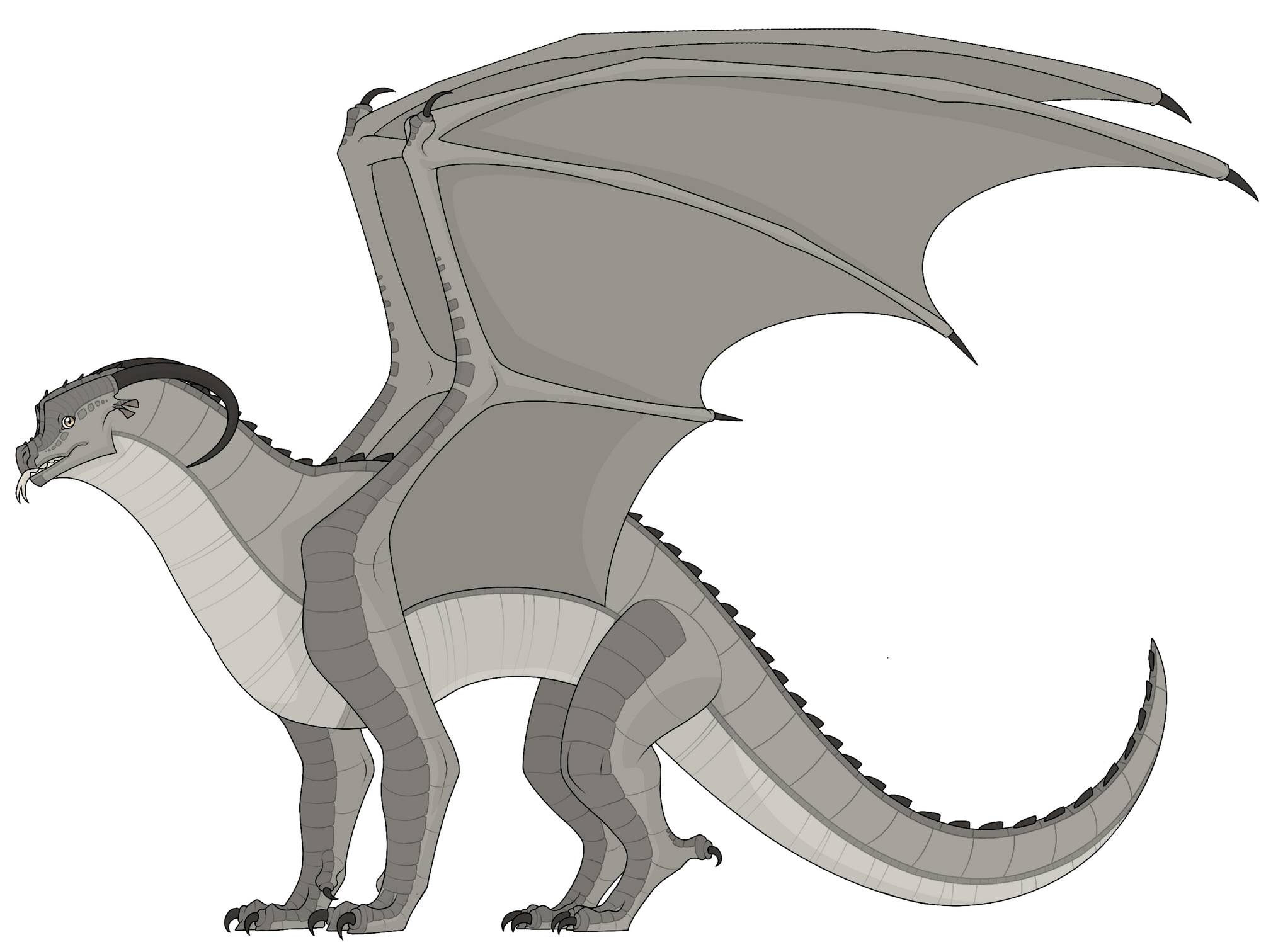
Basics
Dirtwings are facultative carnivore dragons that populate the northern landmass of Patheon, which is covered in incredibly rocky terrain, hills, cliffs, mountains, ravines, and scattered thick forests. Dirtwings primarily populate the center mountain range, known as the Peaks of Granite. The mountains contain incredibly complex and expansive cave and tunnel systems, which dirtwings have evolved to easily navigate.
Dirtwings are a unique tribe among the continent, the reason being that they do not have a proper civilization or clear signs of advanced intelligence that one would expect of a tribe. They are incapable of speech, and exhibit many behaviors typically seen in wild animals.
Dirtwings are the descendants of Mountainwings, who officially went extinct just over two thousand years ago, preceded by the near two thousand year span after the Massacre of the Mountainwings. Stonewings continuously hunted Mountainwings down for centuries, driving their numbers and hiding places down until their survival methods had to evolve, and the need for more advanced education and traditional speech became less important than staying alive long enough to reproduce. This is how Mountainwings eventually became dirtwings, and since the shift, their cognitive abilities have changed in many ways, as well as their physical abilities.
The true intelligence of dirtwings has been frequently debated for centuries, but every few decades, discoveries are made.
Intelligence
At first glance, Dirtwings don’t seem much smarter than your average lizard or goat. And in a few ways, they aren’t. But if you look closer, these dragons have a lot more going on under the surface than you’d expect.
While the way their throat and vocal chords are structured may not allow for speech, their body language vocabulary along with the array of sounds they can make does compensate to an extent, but not entirely.
The amount of concepts they’re able to convey to eachother via physical signals, body language, or sounds includes but is not limited to; Most emotions (happiness, sadness, jealousy, spite, fear, anxiety, sorrow, anger, enjoyment, love, confusion, etc.), hunger, thirst, exhaustion, pain, wanting, friendliness, danger/alert, territory, curiosity, etc.
Certain pieces of knowledge about specific things can also be passed down through specific generations (an example being eating grass if your stomach hurts). Typically a dirtwing will experience something, come across something that helped, and pass that knowledge down to their dragonets if it’s helpful for survival. Some things are more common knowledge among many dirtwings, and some things are more obscure, like specific locations serving different purposes. If something especially harmful or distressing happens to a dirtwing due to a specific thing or being in a specific location, the dirtwing will tend to avoid that thing or location for the rest of their life, and often teach their dragonets to avoid the same.
Dirtwings have an excellent memory. They’re able to remember specific things from decades ago if they’re old enough, and can remember certain faces and smells for their entire lives depending on the impact it had on their lives.
Despite their intelligent traits, there are many things dirtwings can’t do. They are unable to understand speech (alongside being unable to speak), they do not make tools, they don’t adorn themselves with materials (accessories), they can’t build complex structures (outside of nests and tunnels), they can’t express emotions through their faces like other tribes do,
Social Structure
Dirtwings are almost never solitary. Most tend to stick with the families they’re hatched into until they find a mate to have eggs with. They find safety in numbers and groups (typically referred to as clusters), and it’s also common for dirtwings who have trouble finding mates to form new clusters of non-familial dragons. Clusters are tightly knit and the dragons within them typically care for the others, and will notice if one of them is in pain or missing, often searching for them by scent. Dirtwings will also mourn the loss of cluster members if a death or disappearance happens.
On rare occasions, dirtwings will either leave their cluster or lack one entirely. These dragons typically have a higher chance of being killed by stonewings, and the reason for their lack of a cluster can be countless reasons, including being kicked out by the others for various reasons, examples being unsafe/aggressive behavior to other members, poor survival skills, sickness, or generally putting the cluster in danger. Being kicked out of a cluster is more common with non-familial clusters than it is with familial ones, but it can still happen to families. Dirtwings may also leave clusters on their own accord for any number of reasons.
Clusters usually have one dragon that takes on most of the responsibility of protecting the others and guiding them. This is almost always the oldest dirtwing of the group. These dragons are typically referred to as pillars. If a pillar dies, the next oldest dragon in the group will typically take charge.
If a familial cluster hatches a dragonet with a disability (typically blindness or deafness), whether the dragonet is kicked out of the cluster or not can be very dependent on the structure of the cluster. If the family is very close and caring for eachother, the disabled dragonet may be kept and taught despite the potential danger they could bring. If the family is less emotionally attached to one another, the dragonet will be removed for the safety of the cluster, and those dragons typically don’t live for much longer.
Behaviors
Dirtwings have various behaviors that are consistent among the tribe. One of the most fascinating is how they behave during mating season.
Mating/Family
When male and female dirtwings are searching for mates, they will gather at the base of Eagle Mountain like all other dirtwings during this time. For a full week, dirtwings will tussle with eachother, either butting heads, fighting, or asserting dominance. Both male and female dirtwings participate in this, as it makes way for the most resilient and strong dirtwings to have time with one another. Being able to hatch dragonets with healthy, resilient genes that gives them a better chance of surviving stonewings is the most important thing. By the end of the week, the most resilient dirtwings remain, with all others either having keeled from exhaustion, or left. The remaining dirtwings go on to the next phase of mating season.
For the next month, various physically demanding activities are shared between males and females. These activities can consist of hide and seek, group hunting, a version of tag, coordinated pair gliding, mock fighting, and more. Not only does this help figure out who’s the most physically fit with the best genes, but it also allows for the dirtwings to form emotional bonds with one another through games and activities, making it easier for mates to choose each other. Certain dirtwings might also come up with or know of more niche and specific games that may be taught through families. Once a dirtwing has picked their mate, those two dirtwings will not separate unless one dies.
Dirtwing nests are typically composed of gravel, plant matter, and dirt. This is where their eggs will be laid, and mothers rarely leave the nest, leaving the father to bring her food. New dirtwing mothers tend to be significantly more protective of their dragonets than seasoned mothers, which also makes them far more aggressive and alert. Dirtwing dragonets tend to be very curious, playful, and energetic. They will frequently play games with eachother which is beneficial for various survival reasons. Mothers and fathers will take equal part in raising dragonets. Family clusters almost never separate, and will sleep in their dens together, the mother typically covering the rest with her wings.
Territory
Dirtwing dens and living areas tend to be within caves and tunnel systems, but are rarely in more open areas. These more open areas must be fought for, especially desirable ones. A dirtwing in a desirable spot must be strong and have enough stamina to establish their territory and fend off other dirtwings trying to take it. If a dirtwing is in an area for long enough, their smell will remain even when they’re gone, allowing other dirtwings to know it’s not free space. Scratch marks in the stone and ground also send a signal that this space is occupied.
A small amount of dirtwings may also take interest in collecting certain things such as leaves, stones, sticks, feathers, bones, and more. An even smaller amount might also dig for gems or shiny rocks to keep in their den, but this is nearly unheard of.
If territory is not available to a dirtwing or cluster but is desperately needed, the dirtwing(s) may begin to dig out their own den in softer ground for a place to sleep and recoup.
Body Language/Touch
Dirtwings have various forms of body language. The slightest gesture or change in posture can mean any number of things. Dirtwings also heavily utilize touch as a way to communicate with one another, especially within their cluster. Brushing wings together is a sign of affection, and touching noses together is a sign of intimacy, as their noses are one of their most sensitive areas. Spewing smoke from their nostrils is the highest sign of aggression and is often met with either immediate backing down or an intense fight. They may also thump their tail on the ground to express annoyance. The louder the thump, the more annoyed they are, which means you should stop doing whatever you’re doing. MORE BODY LANGUAGE INFO TBA
Navigation
Dirtwings are unnaturally skilled in navigating underground tunnels and caves. They seem to have an acute sense of direction at all times, and never get lost. They also seem to be able to tell if an area of a cave is unstable, and know to tread lightly or turn around. Their night vision also makes it easy for them to see where they’re going. Dirtwings tend to have an adequate mental map of whatever underground system they grew up around or travelled the most often, but they can develop new mental maps of other areas if they spend enough time in them.
Dirtwings are not good fliers. They can barely take off from the ground most of the time, but this is due to the persistent, intense winds that the peaks of granite have maintained for thousands of years. They rely on these winds to glide on and travel between mountains and areas, and as a result, their wing strength has decreased over time. If they’re not in a place with wind, they have a very hard time taking flight.
Other
As their name would suggest, dirtwings have a special relationship to dirt. Their territory is littered with bare dirt patches devoid of grass or rocks, and these areas are frequently full of dirtwings rolling and relaxing in them. Not only does dirt help relieve and heal their injuries and soreness, but it’s also a valuable social interaction for them, and a good bonding activity for their cluster. Some dirtwings can even be seen collecting dirt in their mouth and bringing it to a clustermate with an injury on occasion. They’re highly aware of the properties dirt has to them and know how to utilize them to an extent.
Powers
Dirtwings have a wide variety of abilities they’ve evolved over the centuries to better evade stonewings and live in their environment.
Scent
Dirtwings have the most sophisticated sense of smell in Patheon. They’re able to easily follow scent trails of other dirtwings, smell and track prey, as well as sensing if meat is rotten or not. They’re also very heavily wired to detect the smell of stonewings.
Night Vision
Dirtwings have incredible night vision. This is one of their oldest abilities dating back to the time of Mountainwings, and it makes navigating completely unlit tunnels and cave systems much easier.
Air Expulsion
They’re capable of expelling a majority of the air from their bodies in order to fit through small cracks and gaps in tunnels as wide as their head, places where stonewings can’t fit. As a result, they’re capable of functioning without air in their system for up to a half hour. This also allows ease of escape if caves get flooded.
Smokebreath
Dirtwings are capable of breathing out large amounts of smoke as opposed to fire. This is typically used as a last-ditch effort to evade stonewings if all else fails, but it can also be used for various other purposes.
Climbing + Grip
Dirtwings are prolific climbers and have an incredibly strong grip that is nearly impossible to release. This makes it easier to navigate the many rocky structures of their territory, and it makes capturing prey much easier.
Dirt Usage
If a dirtwing is injured, itchy, sore, or achey, rolling around and covering themselves in dirt is the best way to relieve and heal those ailments.
Appearance
Dirtwings are compact dragons with lean muscles, smaller wings, and short tails. They’re covered in thick armored scales, especially on their spine and head. Their snouts are squarish with large nostrils, their teeth are large and sharp, their ears have squared edges, and their tongues and throats have a distinct pale white coloration. However, their most distinct feature is their horns, which curve downward and inwards like an ibex or ram. The amount of curl their horns have can vary dramatically, along with the size and length. Older dirtwings tend to have longer and more curved horns. If a dirtwings horn(s) is broken, it will not grow back.
In terms of size, dirtwings on average are very slightly smaller than most tribes, but not by much. They still grow the same way, that being they do not stop growing in size as they age, the growing just gets slower as time goes on.
Coloration
Dirtwings tend to be colored similarly to the rocks and mountains of their environment, often being light and highly desaturated colors of any variety, but most commonly red, orange, yellow, green, and grey. Dirtwings with colors that are too light, dark, or vibrant don’t tend to live as long, as camouflage is important for survival. Dirtwings can also occasionally have unique patterns, speckling, or splotching on their scales.
Diet
Dirtwings are facultative carnivores and predominantly eat meat/hunt prey (leopards, sheep, rams, boars, goats, cougars, vultures, falcons, eagles, birds, rabbits, hares, marmots, rodents, yaks, fish, eels), but if prey is not available for prolonged periods of time, dirtwings may resort to plants such as roots, berries, and fruits. Though this is uncommon.
Names
Dirtwing names tend to fall under the following themes; Rocks/Sediments, Dirty/Filth-Related Words & Concepts, and Rock-Related Words/Colors
(DISCLAIMER: Dirtwings don’t actually have or give eachother names in canon. Dirtwings are only given names for the sake of character creation.)
Mountainwings
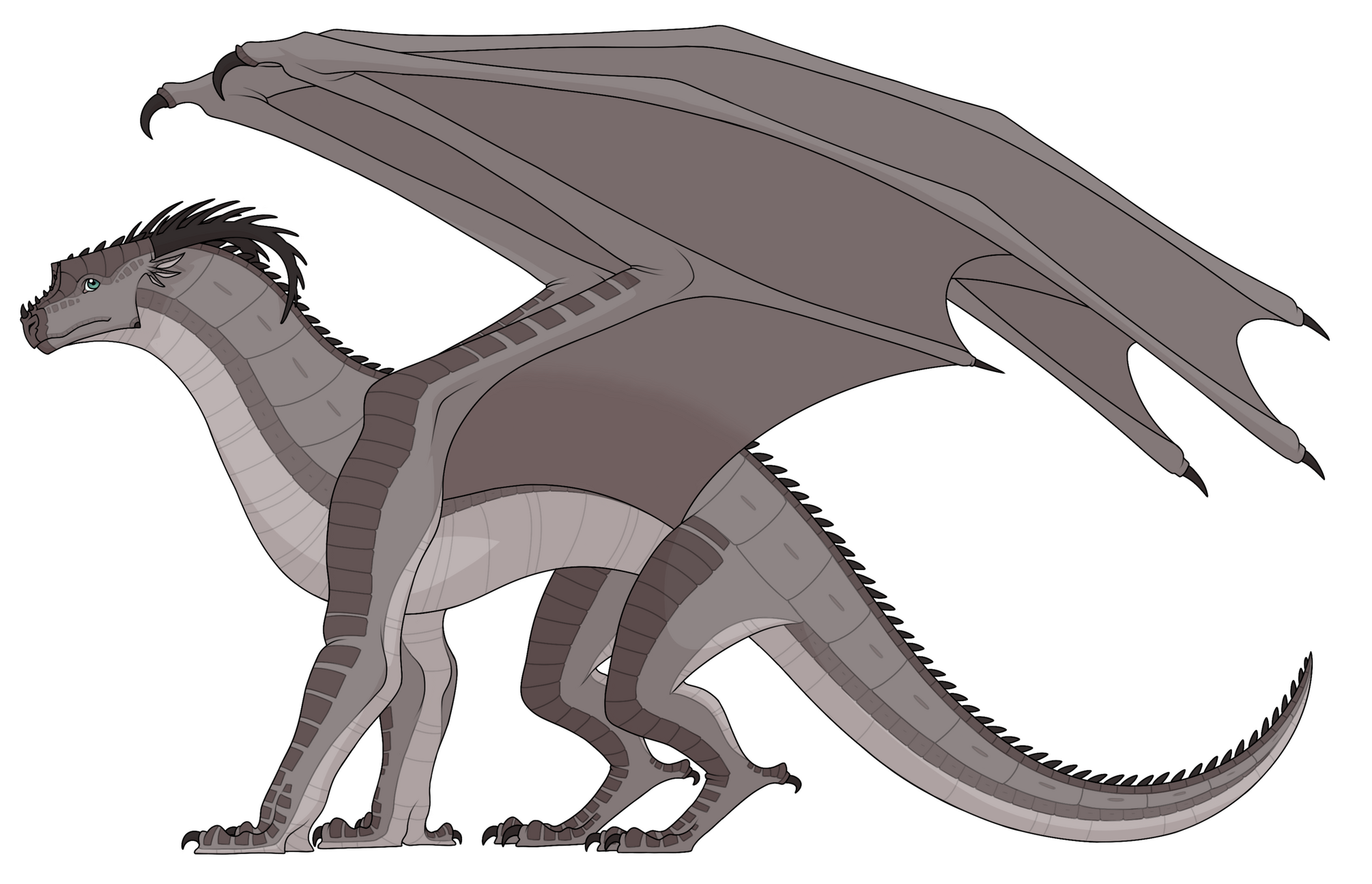
Basics
Mountainwings are somewhat smaller omnivorous cave-dwelling dragons that populate their underground kingdom on the northern tercile of the continent. As a result of the Stone/Mountain war, these dragons have been living miles underground below the Peaks of Granite for the last 1,200 years, and their population number is somewhat lower in comparison to the other two tribes. Partially due to the war and their limited living space. Their egg clutch sizes range from 1 to 3, and rarely 4.
Mountainwings value their tight community and family dynamics, as well as their collective safety. Their history and unique situation influence their culture. They are currently ruled by Queen Mesa.
Intelligence
Mountainwings display incredible intelligence with their countless innovations made in order to tolerate their habitat and way of life, particularly when it comes to agriculture, plant husbandry, and livestock management.
Throughout the last thousand years, mountainwings have cultivated various subspecies of plants that are able to grow without sunlight. As a result, they’ve been able to maintain a steady food source for their tribe, as well as being able to feed their livestock and the food source for their livestock. Another type of plant they’ve cultivated is various types of bioluminescent and glowing plants that are used to light up areas and homes. Since the use of fire is limited (to preserve air quality), many rely on these plants as a light source.
Due to the non-existent supply of things like wood or other woody plants, mountainwings have adopted the use of stone tablets for documenting literature for the most part as opposed to scrolls.
Mountainwings are often very skilled in sculpting and careful structural management. They’re able to tell if something is unstable, and know when to block off a dangerous area, and when to tread carefully. Due to their home being a vast cavern with countless grooves, rooms, and pillars sculpted into it over time, any expansion is greatly discussed and only considered if it is greatly needed. Otherwise, they do not take the risk.
Society
Mountainwings live in a tight-knit community where almost everyone knows eachother, and when something happens, it spreads quickly. Things like hatching days, hatchings, and pairings are big deals that are celebrated by many. Celebrations typically include gifts, most commonly jewelry using various minerals and precious gems that they dig up from tunnels and process. Many families have passed down specific stones or gem jewelry through multiple generations, and it makes up a large part of many families' identities.
While their community is very closely connected, this also comes with downsides. If someone does something bad, or someone is known to be a bully or an annoyance, everyone knows it. This makes it much harder for them to get what they want, or have any attention paid to them. The second worst punishment aside from actual imprisonment in mountainwings society is being collectively ignored by literally everyone. However, if apologies are made and bridges are rebuilt, this can be undone.
While mountainwings have many positive customs and traditions within their society to keep morale high and subjects happy, it can’t be denied that the last one thousand years of their tribe's history and culture have been shaped by fear and paranoia. Their fear of stonewings seeps into every facet of their culture, including art, storytelling, humor, politics, and more. In art and stories, stonewings are always portrayed as nearly myth-like monsters. Something to check for underneath your bed, or something that’ll show up if you do something bad. While everyone is well aware of the reason that they’re underground in the first place, and everyone has a very healthy fear of ever returning to the surface only to be the victim of another genocide, they’ve gone so long without interacting with the other tribe at all that many view them more as something of legend than tangible history.
A mountainwings sense of humor is very unique compared to other tribes due to their similarly unique situation. Most jokes or punchlines relate to (or are at the expense of) stonewings, being buried alive, worms, digging another home even deeper, or getting lost in tunnels. Their terminology and expressions also reflect this.
The place that mountainwings call home has a very complicated history and structure. When the Stone/Mountain war was still active, stonewings would consistently attempt to pry deeper into the underground tunnels and caverns to find any surviving stonewings to wipe out. As a result, any time they were even suspected of being found, the mountainwings continued to go deeper and deeper, even if they had already dug out and established some sort of home. As a result, the current living place of the mountainwings remains under multiple other consecutive layers of abandoned half-dug out caverns and carved villages. However, some of these have caved in over the last few centuries, so exploration is forbidden, and all possible entries to upper layers are blocked off by boulders. The current mountainwing home consists of multiple massive caverns. Almost all the cavern walls have carved platforms leading to dug-out entrances to homes. These span for multiple levels and stories that any dragon can fly up to. The floor typically consists of markets, events, hangout areas, and other recreational things. There are multiple larger areas and complexes dedicated to things like agriculture/gardening, livestock, material production, education, water collecting, hatcheries, and more.
Customs
Mountainwings have few customs or events, but the ones they do have serve to boost morale and community.
Fungal Fest
An annual event in which Mountainwings will all gather at the main ground and perform many fun activities to celebrate their continued survival and safety. A large pot of mushroom stew is cooked, with many mountainwings bringing their own unique ingredients to add. By the end of the event, everyone has some. Other activities of the festival include singing, pottery, poetry circles, riddle wars, hide and seek, and much more. The queen will oversee everything and converse with her subjects.
Riddle Wars
A small game mountainwings like to play, especially at the Fungal Fest. Mountainwings try to come up with clever riddles to present to a group, and whoever has the riddle that takes the longest to solve with the fewest hints wins, along with the fastest to guess all the riddles total.
Mole Race
While moles are primarily a food source, many also like to train them to dig as fast as possible, and have them race against eachother in an elongated tub of dirt. Whichever mole comes out the other side first wins, and the losers are typically eaten. (Listen, if you lived underground your whole life you’d have to start getting creative with how you have fun too.)
Funerals
When a mountainwing dies, almost the entire tribe comes to gather around the body, as most if not all mountainwings know eachother to some extent. Family members and friends will all take turns speaking about who they were and what they meant to them. This can sometimes last for hours, due to how everyone kind of knows eachother. When the service is complete, the body will be brought to the botanical center and buried in containers with dirt, worms, and other bugs to create fertilizer for the soil.
Royalty
Queen
The queen of the tribe is responsible for all aspects of the tribe, including management of food, resources, education, law enforcement, protection, and more. If she has siblings, she will often collaborate with them or rely on them for support and decision-making, to make things more fair. When she deems it the time, she will have a clutch of eggs. If the clutch does not include a female, she will have another until she has one. At a certain time, the queen will choose one of her daughters (if there are multiple) to succeed her, and will eventually pass the crown peacefully, or die on her own, passing it by default. The choosing does not apply if there is only one daughter.
Daughters/Sisters
The queens’ daughters are raised among the tribe like any other citizen, alongside being taught and raised by her mother for her future position. If a queen has multiple daughters, she will train them both and inevitably choose one to succeed her, with the other still being allowed an assisting role, though it is their choice whether to do so. Some sisters may separate from the royal family to live a more normal life among citizens.
Sons/Brothers
Sons of the queen often play an important role in raising the future queen. Princesses often have strong bonds with their brothers and will continue to support them through their time as queen, often collaborating with them or making decisions together. Brothers of the queen tend to have slightly more authority than the average citizen, but not enough to potentially cause problems.
Powers
Mountainwings possess a variety of abilities.
Scent - Mountainwings have an incredibly strong smell, being able to pick up unusual scents from multiple caverns away.
Tail - Mountainwings have very strong tails that they can use in combat. Despite having smaller tails than the other two tribes, they have very dense muscle mass and can easily break bone if well-trained enough.
Night Vision - Mountainwings possess the strongest night vision on the continent. This makes the need for external lighting not as essential, but the bioluminescent plants they’ve cultivated are still important to general visibility.
Fire Breath - Mountainwings are capable of breathing hot, orange-red fire. Not as hot as stonewings, but their use of this is limited due to their environment.
Appearance
Mountainwings are slightly shorter than the other two tribes, and more compact. They have broad snouts, pronged, downward-facing horns, and short, wide wings that are not great for long-distance flying. Their scales are square-shaped, flat, and plate their bodies neatly. Their tails are short but powerful.
Coloration
Mountainwings tend to be similarly colored to the caves and stone around them, occasionally with slight shades/hints of green, orange, red, tan, yellow, or blue. Mountainwings are never brightly colored, often more brownish or grey. Their eyes are frequently blue, indigo, green, yellow, orange, silver, or any variation or shade of such colors.
Diet
Mountainwings are omnivorous with various food sources. Their live food includes moles, gophers, bats, cavefish, eels, salamanders, bugs, and worms. The plants they’ve cultivated to eat include root/bulb vegetables, potatoes, yams, and various types of fungi/mushrooms.
Names
Mountainwing names tend to fall under the following themes; Rock Formations, Minerals/Mineraloids, and Rock-Related Words.
Stonewings (Ancient - Pre-Ravage)
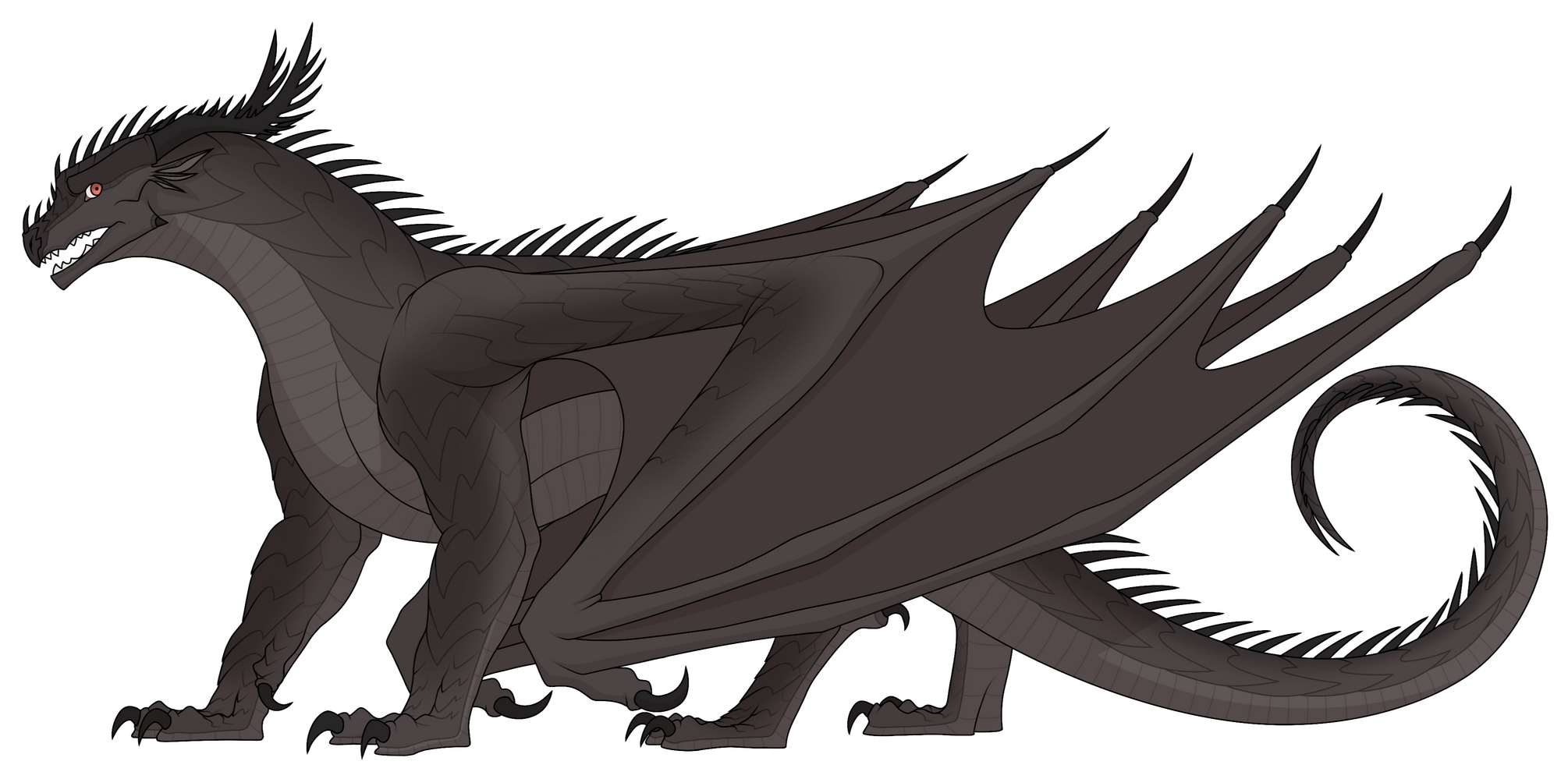
Basics
Stonewings are large, strong, carnivorous dragons that populate the eastern tercile of the continent. They’re a very militaristic tribe with a tendency to overexploit their surroundings, and are often described as bullheaded. They view the other two tribes as lowly, cowardly lizards, while viewing themselves as the utterly superior tribe of the continent destined to control and tread every inch of it. This superiority is instilled into dragonets as soon as they’re able to read, and multiple years of schooling alongside mandatory intense combat training make them into the tribe they are. Their entire philosophy stems from their actions following the Great Eruption, where the ones who survived believed to have done so for a reason.
Their overexploitation of not only their own land, but also mountainwing land, has led to a shortage of resources and food, along with the perceived extinction of multiple animal species. This combined with their exponentially growing population only continues to become a bigger issue with each passing generation, as more dragons die of starvation and sickness. They are currently ruled by Tribemaster Ravage.
Intelligence
Stonewings are highly intelligent and have maintained many advancements and technology from what little knowledge was passed down from their ancestors after the Great Eruption, as well as many new discoveries. Topics and skills these dragons excel in include; Construction, weaponry, combat, military, mineral farming, material utilization, fortifying, education, training, and history.
Stonewings have littered their land with countless structures, buildings, and homes primarily made of stone brick and fired clay held together by mouth amber and mud. They frequently utilize light sources like torches, lanterns, and lamps to light up their settlements, villages, and homes at night and in dark buildings. Their fire breath makes this easy.
Another pride of stonewings is their use of combat training and weaponry. Their education system is relentless to young dragonets and is built to turn every dragon into a potential soldier. They’ve created and invented countless weapons like spears, daggers, axes, saws, whips, hammers, harpoons, and more. Though they take great pride in their weaponry, they believe a soldier is only as good as their own physical strength, so most training tends to be claw to claw, though weapon training is still present.
Society
Stonewings have the highest population of any tribe currently, which means they also have the widest spread of settlements within their territory, and even somewhat outside their territory. The capital surrounds the tribemasters’ stronghold, where the most fierce, high ranking, loyal stonewings reside. Rankings and respect begin to lower and dwindle the further away from the capital you reside in. Those who have sworn their lives and loyalty to Ravage reside within the stronghold, as they are the most dedicated to her and her cause, having been thoroughly conditioned to trust every word she says and to never question otherwise. These are the highest ranking individuals in the kingdom, and they are often taught from hatching to treat her like a god. The higher your rank is, the more priority you’re given in scheduled hunting time, so this has made the tribemasters’ legion of followers even greater.
Though ravage has only been in rule for 22 years by now, her influence within the kingdom proves to be fast-moving and highly effective. Her mother had already instilled new education programs to teach young dragonets to respect and treat the future tribemaster like a deity, so her reputation and public perception has been hard-coded into their society and multiple generations. Her loyalists and followers make it easy for her to control what she wants, as it adds extra muscle and numbers against anyone who might think about opposing her or her word. A very small number of her absolutely most dedicated followers follow her close, and are typically called her inner circle. The most respected and lavishly treated dragons in the entire nation.
Egg clutches for stonewings tend to range from 2 to 4 at a time. Parents often don’t play a major role in their dragonets lives, preferring to have dragonets raised by the community and teachers/trainers. Stonewings are taught to respect those in positions of authority, especially those of the tribemasters’ guild.
Stonewings are raised on fear and power. They are taught to fear power, but to crave it and fight for it as well. They are taught to view the other two tribes as enemies that need to be put in their place, utterly inferior to their own. They are taught what the tribes look like, and to kill them if they ever see one. Though, with recent ruling, outright attacks on grasswing territory have been minimal, as the tribe has other problems to worry about at the moment.
Stonewings and their territory have begun to creep into Mountainwing territory. Building outposts and watchtowers to keep an eye out for any mountainwings, and to extract minerals and rocks from the ground and return to their territory. They practically infest the eastern side of the land, making it a rather dangerous trek for any grasswing looking for special rocks or minerals. They remain unaware of the mountainwings current hiding place with many spreading rumors that they’ve gone extinct, seeing as that one hasn’t been spotted in centuries.
The stonewings’ biggest problem that prevents them from being as fearsome as they believe to be destined to be is their lack of food and overpopulation. Plainly, there’s too many stonewings and not enough food. As stonewings are carnivorous, they need meat and prey to live, and that’s becoming increasingly harder to come by as their numbers increase and their settlements stretch further into their land, driving out most other wildlife. They’ve already caused multiple animal species to seemingly go extinct within the last few centuries, and many are becoming desperate, even scrounging for prey in mountainwing territory, and rarely even grasswing territory. It’s gotten to the point that dragons are dying in the streets and in their homes almost every day. Many are looking to the tribemaster for a solution to this problem, and she has assured everyone that their problems will disappear soon. They just have to wait until the time is right.
Customs
Stonewings have very few customs they regularly practice anymore due to their dire situation, but at least one has emerged due to Tribemaster Ravage’s reign.
The Sacred Promise
This is the final act a stonewing must do in order to prove her undying loyalty and worship to the tribemaster to become one of her closest followers. After years of trials, training, education, and conditioning, if a stonewing wants to become a complete follower to Ravage, they must cut an X shape into their own forehead without stopping for a break or giving up. Not only does this show a level of devotion that the tribemaster approves of, but the scar also indicates the dragons’ high status to anyone with a passing glance.
Royalty
Tribemaster
The Tribemaster is the ruler of the tribe as the name suggests. She is in charge of all policies, events, laws, education, and battle planning. The tribemaster is the most respected, revered, and feared member of the tribe, embodying what all the stonewings need. Right now, that is a competent leader who will free them from the pain they’re all experiencing. And that is what the current tribemaster is promising.
Daughters/Sisters
When the tribemaster deems it a fit time to lay her clutch, she will do so. The dragonets will all hatch together, and will be raised by the higher rank tutors and trainers. Daughters of the tribemaster, all being potential heirs to the position, are given extra education, training, and more in-depth teachings about the history and values of the tribe.
Before the reign of Ravage, daughters would be able to choose when they challenge their mother for the position, fighting to the death until one of them is left. If a daughter wins, she typically kills the rest of her sisters shortly afterwards.
Sons/Brothers
Sons are trained and taught alongside their sisters with the highest ranking teachers and trainers, but expectations are typically not put onto them by society. However, they typically are in danger of being killed when one of their sisters becomes the tribemaster, so they often tend to stick close to them and prove themselves to be useful. The alternative is being killed or running away, which also usually ends up a death sentence regardless.
Powers
Fire Breath - Stonewings are capable of breathing hot, orange fire.
Strong Jaw - Stonewings have the strongest bite in all of Patheon, being able to snap most prey animals in half with one snap of the jaw.
Sharp Claws - Stonewings have incredibly sharp claws. While it’s hard to accidentally cut themselves due to their own tough scales, this makes climbing things and ripping apart prey much easier.
Mouth Amber - Stonewings’ most unique ability is a substance they’re capable of producing from specific glands in their mouth. This substance has been named ‘mouth amber’, and is the stickiest, most adhesive substance known in Patheon. It only becomes sticky once it leaves the mouth, and is taught to be aimed at a young age in order to capture prey. Outside of hunting, mouth amber is primarily used for construction and the development of tools and inventions, as it frequently replaces the need for tying things together.
Appearance
Stonewings are bulky, spike-covered dragons. Their muscle mass is naturally dense which is covered by thick, sharp, hard armor-like scales all along their body. They have a frayed tail tip, splitting off into two tips a few inches from the end, alongside sharp spines and spikey pronged horns with sharp angles and countless spikes like barbed wire. Their tongues are near-black.
Coloration
Stonewing coloration tends to be any dark/desaturated or near-black color. Hints of colors are very common, but being a bright/saturated colored stonewing is unheard of. They’re typically the colors of rocks and mountains at night, and their eyes are frequently orange, amber, yellow, white, red, or lime green. Though other colors are possible.
Diet
Stonewings are carnivores and eat almost anything they can catch; (Bears, deer, moose, snakes, fish, owls, wolves, coyotes, etc.)
Though they have seemingly caused multiple species to go extinct due to their overpopulation issue; (wolverines, bobcats, porcupines, foxes, sables, elk, beaver)
Names
Stonewing names tend to fall under the following themes; Weapons, Sharp Things, Fearsome Animals, and Fearsome Concepts
Thank you Aresaire for help with this base!
Grasswings
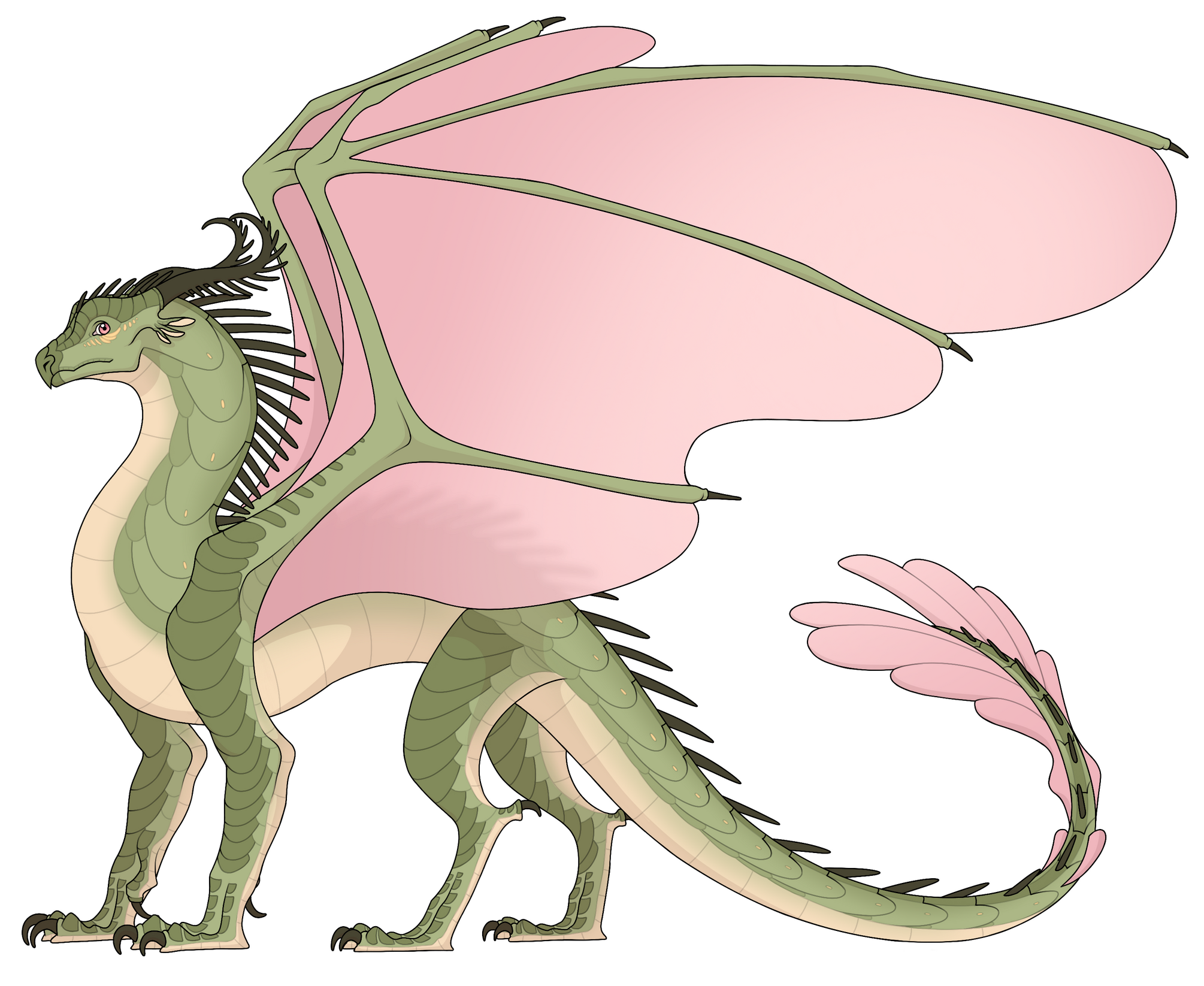
Basics
Grasswings are herbivorous dragons that populate the southern tercile of the continent. They’re surrounded by lush forests and meadows, grasslands, and fields. They’re known for their dedicated religious practices and natural beauty. Their practices and beliefs stem from the Great Eruption, an event that was the catalyst for their change into grasswings. How their ancestors recounted and interpreted this event has shaped their beliefs and how they live their everyday lives, sometimes for the better and sometimes for the worse.
Grasswing clutch sizes never exceed 1 egg at a time. They are currently ruled by Empress Spicata.
Intelligence
Grasswings are highly intelligent and have cultivated countless advancements and discoveries in technology and science. After the great eruption, they essentially started over in terms of their knowledge (believing they had to start from square one in order to appease their god), so they’re somewhat less advanced than the mountainwings or stonewings, but they’re making fast progress, especially in terms of food and food preservation. As grasswings are herbivores, they have to rely on what they can do with plants instead of what their local fauna can offer them, aside from milk.
Culinary/agricultural advances include; Creation of wine, baking, yeast utilization, seasoning, selective plant breeding, plant-based oil, creation of textiles with natural fibers, fruit fermentation, grain processing/flour, use of milk, utilization of sugar, dry preservation/mills, advanced farming/agriculture, and more.
Grasswings are also very prolific in architecture, construction, and utilization of materials. Their oldest buildings are the Obsidian Temple, Grand Stadium, and various other smaller structures. They maintain this architectural style to an extent, preferring stone/clay bricks and smooth rock to build more important and long-lasting buildings (including a unique shape language for many buildings), but most residential areas and villages primarily use things like wood, textile, and various other plant stem material to build their homes, schools, stores, and other structures.
Their engineering is in early stages, at least in terms of their weaponry and general technology. Glass is almost never utilized in anything, and their weaponry remains limited to melee weapons and the occasional ranged weapon relying on projectile force. They’ve also developed armor for their guards and soldiers in order to be able to defend themselves from skirmishes with stonewings. Grasswings are also relatively skilled in basic science, math, and engineering.
Society
While grasswings are ultimately brought together by their religion, ruler, and beliefs, their overall community is rather fragmented and spread out among the land. There are multiple villages scattered throughout their territory, all rather self-contained with their own unique quirks and traditions. Some villages are rather tightly-knit communities while others may act more apathetic or distant to neighbors, and on rare occasions are even downright hostile.
Their laws and how they enforce them are incredibly strict. Guards in every village are trained in the capital, and keep constant watch for any rule breaking or blasphemy. If any dragon is suspected of illegal or blasphemous activity, they are taken to the empress herself for judgement.
The utilization of fire is incredibly controlled and limited to the average citizen. Each village has a designated building/service that provides the use of fire three times a week at a scheduled time, and anyone who wants to cook food or bake clay or anything else that requires heat or fire must bring their items to the flameworkers. If you bring it in too late, you have to wait until the next date. Anyone seen creating fire without proper admission is apprehended and judged by the empress. The only acceptable way for anyone to create fire in the kingdom is to use friction with sticks and rocks. Using firebreath is punishable by death, and this is taught to every grasswing the moment they’re able to comprehend language. It’s the most important law.
Their interpretation of the old texts of the post-eruption era define how their society functions in almost every way. Grasswings are devout followers of their god, Obsidian. All the villages have weekly mass prayer sessions in their designated worship spot, and failure to appear at these without proper excuse may be met with a fine or a cut on the arm.
Grasswings also heavily control their population, as the old text states it cannot exceed a certain number. As a result, all hatchings and deaths are accounted for and documented by seasoned record keepers. If the population is nearly at the established limit, dragons are forbidden from having eggs in order to not wear Obsidians’ blood too thin. If eggs are laid while the population is at its limit, the eggs may be destroyed unless someone dies within the next six months. Until that point, they are contained in a secure location where the parents can’t hide them. If a dragon or couple wants to have an egg while the population is at a limit, they are permitted to sign up for a waitlist.
The Land of Grass and its society consists of 6 main sectors. The main being the capital where the most dragons reside, alongside the empress and the Obsidian Temple. This is also where the Ember Festival is held. All grasswings will visit the capital at least once in their lives, typically for their 7th hatching day. The other five are the largest villages, all having unique names, customs, prides, and cultures. Though their religious practices remain the same, along with law enforcement, which stems from the capital.
Customs
Grasswings maintain countless customs, events, and small rules/regulations within their society.
Ember Festival
By far the largest event in the kingdom, and the most unified the tribe is at any point in time. The festival is held for multiple reasons, being the passing of the year, celebrating the longevity and wonder of Obsidian, and celebrating the tribe itself alongside the empress. The festival is officially started when the empress lights the Obsidian Torch with her firebreath, one of the only instances she’s permitted to use it. Events include games, performances and plays, dancing, singing, special treats and baked goods, as well as the largest mass worship in the entire tribe. Offering piles can often reach heights taller than a dragon. Offerings may consist of food, artwork, and more. All offerings are burned at the end of the festival and the ashes are spread across the kingdom. The night ends with a mass prayer alongside the empress and the bloodletting of anyone who offers.
Passing of The Crown
This is the most sacred and widely attended event in all of grasswing civilization. On the day the daughter of the Empress turns 20 years old, the ceremony is carried out. The entire tribe will attend as the Empress leads her daughter to the entrance of the Obsidian Temple, and the daughter will present her wrist. The empress will make a cut in her daughter’s wrist, and drip the blood into a sacred bowl. She uses this blood to mark the royal symbol on her daughter's head. Once this is done, the daughter will light the Obsidian Torch with her firebreath, thereby deeming her the new empress.
The mother will continue to live alongside her daughter and provide assistance when possible, though taking on significantly fewer responsibilities for the next 20 years. If these 20 years pass and the mother is still alive, she will sacrifice herself in order to permit her daughter to have dragonets, continuing the cycle. An empress’s mother and daughter cannot be alive at the same time.
Funerals
Funerals are a time of contemplation for grasswings. Family and friends of the deceased will gather at the center pit near the Obsidian Temple in the capital. The body will be lowered into the pit, which has been used for funerals for two thousand years. The body is set ablaze, and whatever ashes remain are retrieved and embedded into the dirt. The location can vary depending on the deceased’s final wishes, often being their home village.
Ex-Empress Funerals
When a previous empress passes away, the funeral service is much more grand than any other funeral. A separate fire pit is in place for empresses (again, used two thousand years) and is lit by the current empress, using her firebreath. The previous empress is covered with soft cloth and grasses, typically each individual floret being placed by a different citizen. Her ashes will be spread to the earth just like any other dragon, but a very small portion will be kept in the Obsidian Temple.
Hatchings
When a dragonet is hatched, families will gather to celebrate, usually by spending time with eachother, eating special food, and singing.
7th Hatching Days
On every grasswings’ 7th hatching day, they are required by law to come to the Obsidian Temple and perform their first bloodlet at the center offering area. A single cut and a few drops into the receptacle is all that’s needed. The empress oversees this event.
Yearly Offerings
Grasswings are required to offer to Obsidian at the temple at least once a year. Offerings can be either food, jewelry, artwork, blood, tears, or other physical things. Yearly offerings are typically given a lot of weight, time, and thought.
Various Other Customs
One of the other smaller customs that grasswings have is that speaking aloud after sunset and before sunrise is forbidden. This is why sign language is one of the first things a grasswing is taught, as it is commonly utilized at night. Grasswings are discouraged from making any substantial non-vocal sound during nighttime as well, and often tread lightly and carefully.
Royalty
Empress
The Empress is the sole ruler of the Grasswings and also carries a role similar to a priest. All religious matters and test interpretations are dictated by her, as she is seen as the closest to Obsidian by blood. Any major changes in laws or public programs are decided and executed by her alone. The empress is also responsible for judging any law-breaking or blasphemous dragons herself, deciding their punishment or fate with little outside help. When an empress decides she is ready to begin raising her successor, she will have one egg at a time until she hatches a female.
Daughter
Once one female is hatched, the Empress will raise her either on her own or with her partner. The Princess is educated by her mother and the highest scholars in terms of their culture and sacred customs, along with all other aspects. Though, she often follows her mother on travels to other areas of the kingdom to get an idea of what it’s like outside the capital, and will sometimes make connections.
Sons
When an empress hatches a son, they are sent to be raised by a trusted surrogate. Empresses will interact with their sons on occasion, but it doesn’t take priority. Sons of the empress are also allowed to interact with their sister when possible, as well as being allowed to know that they’re related. They hold no higher stance or title than the average citizen, and are treated like anyone else.
The only difference in how they are treated is the incredibly strict law forbidding them from fathering biological children, as the old texts dictate they cannot complicate the most sacred bloodline in the tribe. These dragons are more than welcome to adopt, but if it is discovered they have fathered biological dragonets, the eggs and/or dragonets will be sacrificed.
Powers
Fire Breath - Grasswings are physically capable of breathing fire, but only females of the Empress’s direct bloodline are permitted to breathe fire on very specific occasions. Fire breath is punishable by death otherwise, so it is never used.
Light Resistance - Grasswings are capable of handling much higher intensities of light without damaging their eyes.
Flight Skill - Their uniquely shaped wings and opposable tail fins allow for incredibly sharp midair turns and spins/maneuvers, making them some of the most intricate and majestic flyers in all three lands, being able to weave between trees and buildings with ease, as well as performing tricks in the air that the other two tribes are incapable of.
Appearance
Grasswings are thin, graceful dragons with long, thin, rounded spines along their backs, and intricate pronged antler-like horns on their heads. The amount of prongs or stubs can vary from dragon to dragon. Their wings are a unique flower-like shape, and their tails end in two maneuverable fins with a similar flower shape. Their claws all have slightly more rounded edges than the other two tribes. It’s rare to see a sharp end on a grasswing. Their snouts also end in a slightly sharper and longer point than the other tribes, making their bites pack a little more punch.
Coloration
Grasswing colors can be any shade or form of green, pink, magenta, purple, yellow, orange, amber, tan, or any near-white variation of said
colors.
Diet
Grasswings eat a wide array of foods, typically cooked and prepared with multiple ingredients (i.e bread, milk, oatmeal, soup, bakes). Many dishes also include vegetables and fruits of various kinds (namely apples, lettuce/leafy veggies, carrots, onions, tomatoes, potatoes, wheat/grains/oats, rice, berries, etc.)
Names
Grasswing names tend to fall under the following themes; Grassland Plants, Grassy Landscapes, Types of Grass, Plant Anatomy, and Crops/Vegetables.
Prongwings
Basic Info
Nearly all documentation of Prongwings were destroyed in The Great Eruption.
Intelligence
Unknown
Royalty
Unknown
Powers
Unknown
Appearance
Unknown
Names
Unknown
Site Update Log
- 6/15/2022 Website Created
Previous update logs missing
- 4/6/2024, 10:03 PM EST - Reformatting
- 3/19/2025, 11:51 PM EST - Reformatting, fixed mobile view
- 9/16/2025, 2:46 AM EST - Additions/reformatting to Map areas, removal of rounded edges sitewide, addition of update log
- 11/8/2025, 3:40 PM EST - Addition of "The Word of Obsidian" to Misc., Sagewing, and Grasswing page. Customs for Sage/Grasswings expanded upon and edited.
- 2/12/2026, 10:54 AM EST - Updated Base links from the stash to the Google Drive
- 2/17/2026, 11:27 PM EST - Completely rehauled all the information for all modern tribes, added a "society" section for sage and stonewings, added a "behaviors" and "social structure" section for dirtwings, removed sagewings' ability to mimic sounds + see a wider color spectrum, removed dirtwings' ability of paralyzing venom, general information update with much more in-depth sections.
Added a button to The Word of Obsidian at the bottom of sagewing & grasswing pages
- 2/26/2026, 8:00 PM EST - Completely rewrote/reformatted the timeline to be fully accurate
- 3/22/2026, 8:00 PM EST - Added completely new information to legends tribes, updated legends map